10 Logical Fallacies That Will Tank Your Debate Score
Debate is not just about having strong opinions or speaking confidently—it’s about reasoning well under pressure. Judges, teachers, and audiences aren’t only listening to what you say; they’re listening how you argue. Even a persuasive speaker can lose credibility instantly if their reasoning is sloppy, unfair, or logically flawed.
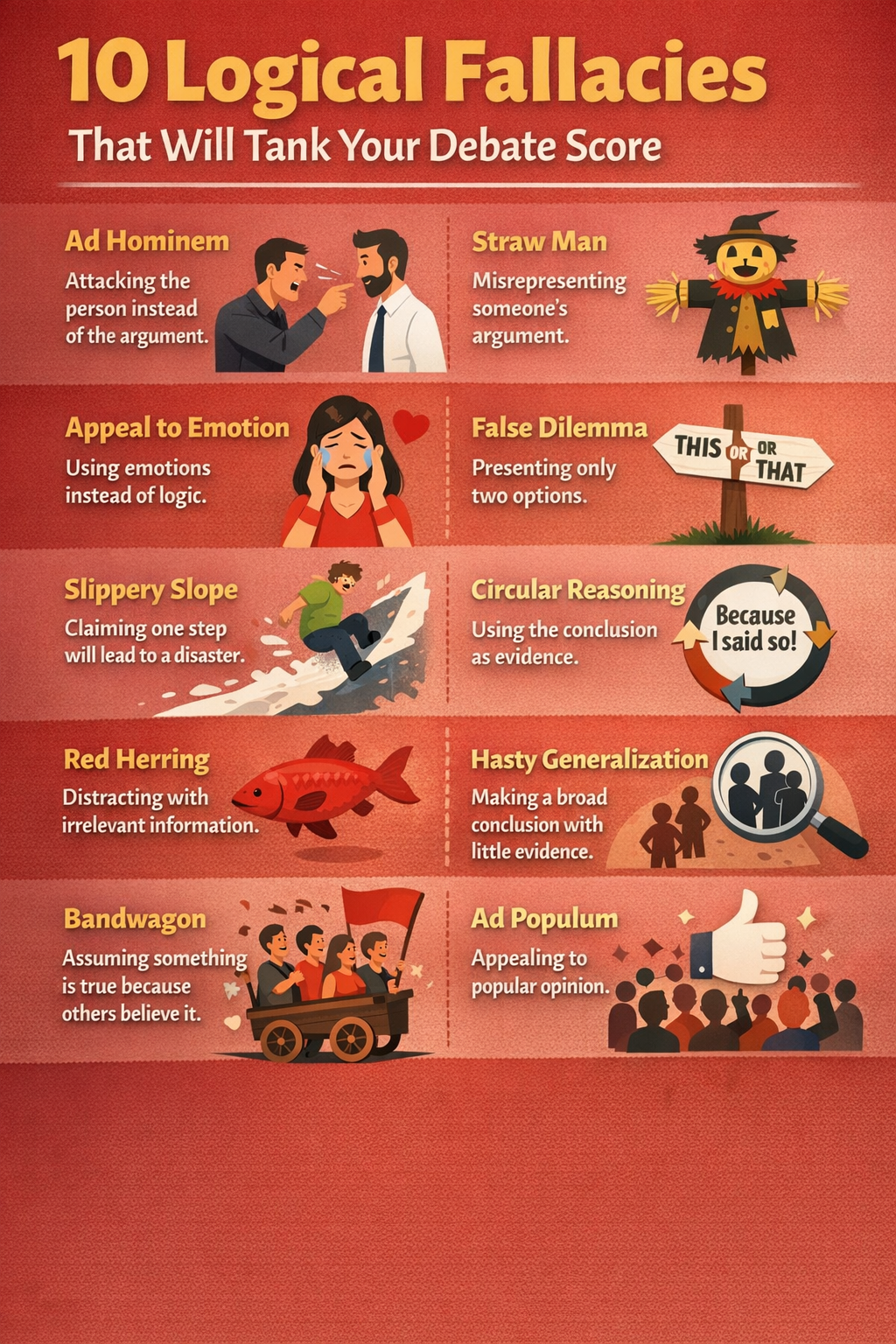
Debate is not just about having strong opinions or speaking confidently—it’s about reasoning well under pressure. Judges, teachers, and audiences aren’t only listening to what you say; they’re listening how you argue. Even a persuasive speaker can lose credibility instantly if their reasoning is sloppy, unfair, or logically flawed.
Logical fallacies are errors in reasoning that weaken arguments. Some are obvious, others are subtle, and many feel convincing in the moment—especially during fast-paced debates. Unfortunately, relying on them is one of the quickest ways to lose points, undermine your case, and hand your opponent an easy win.
This article breaks down 10 of the most common logical fallacies that can tank your debate score, explains why they’re tempting, shows how they appear in real debates, and offers practical advice on how to avoid them. Master these, and you’ll not only argue better—you’ll think better.
1. Ad Hominem: Attacking the Person Instead of the Argument
What it is:
An ad hominem fallacy occurs when you attack your opponent’s character, motives, or background instead of addressing their argument.
Why it tanks your score:
Judges view ad hominem attacks as evasive and intellectually lazy. Rather than refuting an idea, you’re attempting to discredit the person presenting it. This signals weak analysis and poor sportsmanship.
Example:
“My opponent’s argument about climate policy can’t be trusted because they’re not even a science major.”
Whether or not your opponent is a science major has no bearing on whether their evidence or reasoning is sound.
Why debaters fall into it:
Ad hominem attacks feel powerful. They can get laughs, applause, or emotional reactions. In heated debates, it’s tempting to strike back personally instead of doing the harder work of rebutting logic.
How to avoid it:
Focus exclusively on claims, evidence, and reasoning
Ask yourself: Would this criticism still apply if a different person made the same argument?
Replace personal critiques with analytical ones (e.g., flawed data, unsupported assumptions)
Strong debaters dismantle arguments—not people.
2. Straw Man: Misrepresenting the Opponent’s Argument
What it is:
A straw man fallacy happens when you oversimplify, exaggerate, or distort your opponent’s position so it’s easier to attack.
Why it tanks your score:
Judges penalize straw man arguments heavily because they show either poor listening or intentional dishonesty. Beating an argument your opponent didn’t make doesn’t earn points.
Example:
Opponent: “We should regulate social media to reduce misinformation.”
Response:
“My opponent wants to censor free speech and control what people are allowed to say online.”
That leap is unjustified unless the opponent explicitly argued for censorship.
Why debaters fall into it:
Time pressure
Poor note-taking
The desire to score an easy rebuttal
How to avoid it:
Restate your opponent’s argument before refuting it
Use phrases like: “My opponent claims X. However…”
Engage with the strongest version of their position, not the weakest
Ironically, refuting a strong argument earns more credibility than demolishing a fake one.
3. False Dilemma: Presenting Only Two Options
What it is:
A false dilemma (or false dichotomy) presents an issue as having only two possible outcomes when more exist.
Why it tanks your score:
Debate judges value nuance. Oversimplifying complex issues suggests shallow analysis and weak understanding of the topic.
Example:
“Either we ban standardized testing, or we don’t care about student mental health.”
This ignores alternative reforms like modifying testing practices or providing additional support.
Why debaters fall into it:
Binary choices are rhetorically powerful and easy to frame. They create urgency and moral pressure.
How to avoid it:
Acknowledge complexity
Anticipate middle-ground solutions
Avoid language like “only,” “either/or,” and “no other option” unless fully justified
Good debaters don’t trap audiences in corners—they guide them through complexity.
4. Slippery Slope: Assuming One Step Leads to Disaster
What it is:
A slippery slope fallacy claims that a relatively small action will inevitably lead to extreme, often catastrophic consequences without sufficient evidence.
Why it tanks your score:
Judges expect causal reasoning to be supported, not speculative. Unsupported doom scenarios weaken your credibility.
Example:
“If we allow phones in classrooms, students will stop paying attention, grades will collapse, and education will be ruined.”
Each step in that chain requires evidence.
Why debaters fall into it:
Fear-based arguments can be emotionally persuasive and memorable.
How to avoid it:
Provide evidence for each causal step
Use probability, not inevitability
Acknowledge safeguards or limits
Debate rewards careful reasoning, not apocalyptic storytelling.
5. Hasty Generalization: Jumping to Conclusions from Limited Evidence
What it is:
A hasty generalization draws a broad conclusion from too small or unrepresentative a sample.
Why it tanks your score:
Judges scrutinize evidence quality. Weak generalizations signal poor research and flawed reasoning.
Example:
“Two schools that eliminated homework saw test scores drop, so abolishing homework doesn’t work.”
Two schools are not enough to justify a universal claim.
Why debaters fall into it:
Limited preparation time
Overreliance on anecdotes
How to avoid it:
Use large, credible data sets
Qualify claims (e.g., “in some cases,” “tends to”)
Distinguish anecdotes from trends
Precision wins debates; overreach loses them.
6. Appeal to Emotion: Substituting Feelings for Logic
What it is:
An appeal to emotion relies on fear, pity, anger, or sympathy instead of sound reasoning and evidence.
Why it tanks your score:
While emotion can enhance delivery, it cannot replace logic. Judges penalize arguments that manipulate feelings without justification.
Example:
“If you oppose this policy, think about the children who will suffer.”
This avoids explaining how the policy causes harm.
Why debaters fall into it:
Emotional appeals can sway audiences quickly and feel impactful.
How to avoid it:
Pair emotional examples with data
Explain causal mechanisms
Use emotion to support, not substitute, reasoning
Effective debaters move both hearts and minds.
7. Appeal to Authority: Treating Authority as Proof
What it is:
An appeal to authority argues that a claim is true simply because an expert or famous person says so.
Why it tanks your score:
Authorities can be wrong, biased, or speaking outside their expertise. Judges expect analysis, not name-dropping.
Example:
“This policy must work because a billionaire entrepreneur supports it.”
Wealth does not equal expertise.
Why debaters fall into it:
Citing famous names feels like strong evidence and saves time.
How to avoid it:
Use expert opinions as support, not proof
Explain why the authority’s reasoning is sound
Ensure relevance and credibility
Arguments stand on logic, not reputations.
8. Circular Reasoning: Using the Conclusion as Evidence
What it is:
Circular reasoning occurs when an argument’s premise assumes the truth of its conclusion.
Why it tanks your score:
Judges see circular arguments as empty—they prove nothing and demonstrate weak analytical skills.
Example:
“This law is unjust because it’s unfair.”
“Unjust” and “unfair” mean the same thing here.
Why debaters fall into it:
It often happens unintentionally, especially under time pressure.
How to avoid it:
Ask: What independent evidence supports this claim?
Define key terms clearly
Build arguments step-by-step
If your argument goes in a circle, it goes nowhere.
9. Red Herring: Distracting from the Real Issue
What it is:
A red herring introduces irrelevant information to divert attention from the main argument.
Why it tanks your score:
Judges value focus. Irrelevant detours waste time and suggest you can’t address the core issue.
Example:
“Why worry about corporate taxes when crime rates are rising?”
Both may matter, but one doesn’t negate the other.
Why debaters fall into it:
Attempting to regain control of the debate
Avoiding a difficult question
How to avoid it:
Stay aligned with the resolution
Directly answer challenges
Signal relevance explicitly
Staying on topic is a competitive advantage.
10. Bandwagon Fallacy: Assuming Popularity Equals Truth
What it is:
The bandwagon fallacy argues that a claim is true or good because many people believe it.
Why it tanks your score:
Popularity is not evidence. Judges expect independent justification.
Example:
“Most people support this policy, so it must be the right choice.”
History is full of popular but flawed ideas.
Why debaters fall into it:
Consensus feels reassuring and persuasive.
How to avoid it:
Use popularity as context, not proof
Focus on outcomes and evidence
Be willing to defend minority positions logically
Truth is not decided by a vote.
Conclusion: Fallacy Awareness Is a Competitive Edge
Logical fallacies don’t just weaken your arguments—they hand your opponents easy refutation points and signal to judges that your reasoning can’t be trusted. The best debaters aren’t those who speak the loudest or fastest, but those who think the clearest.
By learning to recognize and avoid these ten fallacies, you elevate every aspect of your debating: your credibility, your clarity, and your confidence. Even better, you’ll start spotting flawed reasoning in others—giving you a decisive advantage.
Debate isn’t about winning at any cost. It’s about reasoning well, defending ideas honestly, and earning persuasion the right way. Avoid these fallacies, and your debate score—and thinking skills—will thank you.
Related articles
Should College Athletes Receive a Share of Athletic Revenue?
Debate over whether student‑athletes deserve a cut of the billions generated by college sports.
Human vs. Debate AI: Can an Algorithm Truly Judge an Argument?
Debate AI promises speed and objectivity, but can it truly grasp nuance and persuasion? This post explores ArguFight’s algorithm, its strengths, limits, and why a hybrid human‑AI approach may be the future of fair judging.
How to Use Debate AI to Master Rebuttals, Logic, and Persuasion
Learn how to harness ArguFight’s Debate AI to craft razor‑sharp rebuttals, strengthen logical structure, and boost persuasive power. From evidence sourcing to real‑time feedback loops, this guide shows you step‑by‑step techniques for mastering debate.