15 Cognitive Biases Ruining Your Arguments
Arguments rarely collapse because of bad intentions. They collapse because our minds take shortcuts. These mental shortcuts — cognitive biases — warp perception, distort reasoning, and send debates spiraling into confusion.
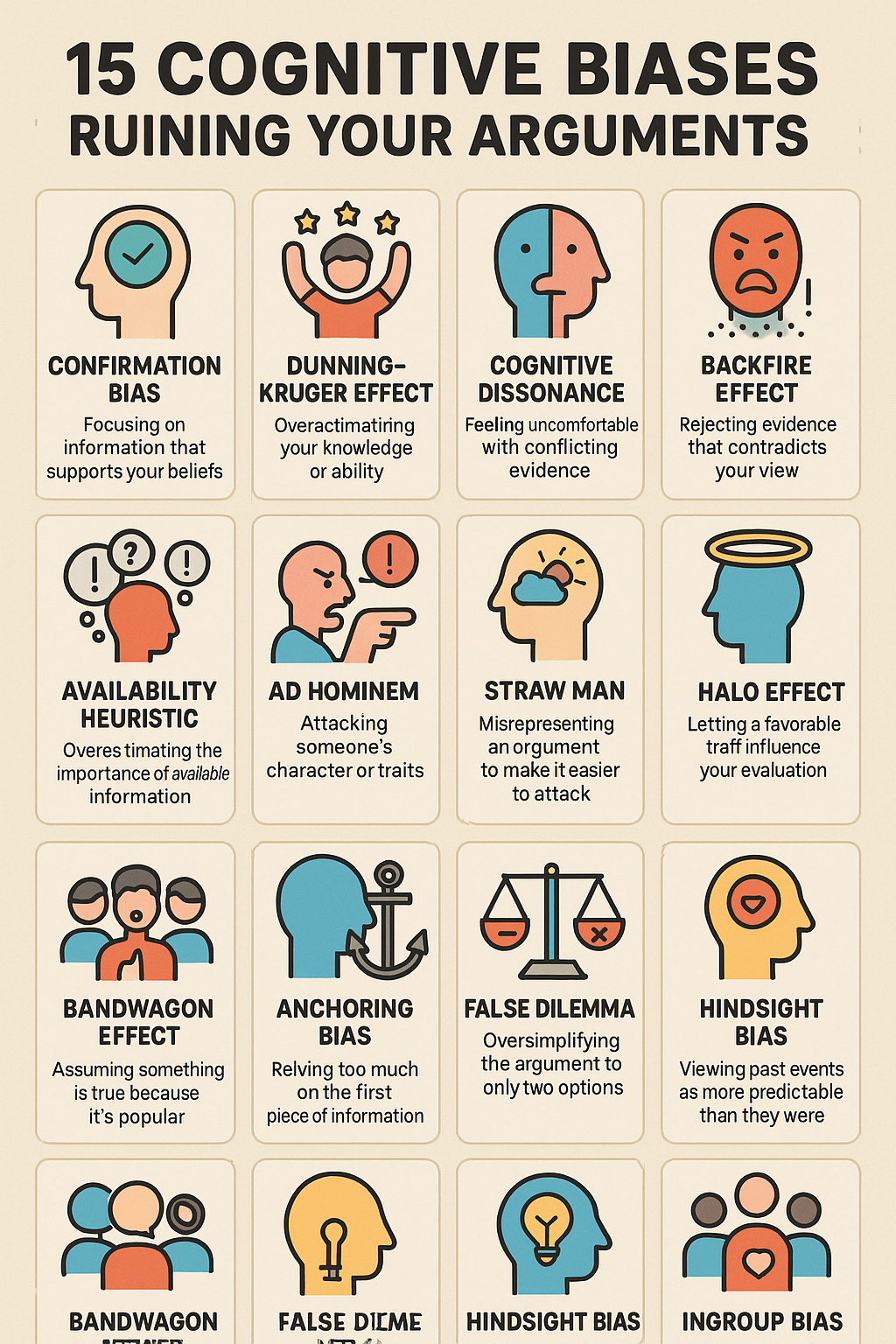
Arguments rarely collapse because of bad intentions. They collapse because our minds take shortcuts. These mental shortcuts — cognitive biases — warp perception, distort reasoning, and send debates spiraling into confusion. If you’ve ever wondered why someone refuses to accept clear evidence, or why a discussion hits a wall, cognitive biases are usually lurking beneath the surface.
Mastering cognitive biases in arguments is like cleaning the lenses through which you see the world. This guide explores 15 of the most disruptive biases and how to neutralize them in your debates.
1. Confirmation Bias
We search for information that supports what we already believe.
Impact on arguments: Opponents talk past each other because both sides selectively choose evidence.
Fix: Seek out sources that challenge your stance before debating.
2. Anchoring Bias
The first piece of information becomes the mental anchor.
Impact: Early claims — even false ones — shape the entire debate.
Fix: Reset the frame by explicitly questioning initial assumptions.
3. Availability Heuristic
We overvalue information that's recent, vivid, or emotional.
Impact: A dramatic example outweighs statistical reality.
Fix: Compare anecdotes with actual data.
4. Dunning-Kruger Effect
People with low expertise often overestimate their understanding.
Impact: Debates get stuck when someone confidently argues from shallow knowledge.
Fix: Ask clarifying questions that reveal depth.
5. Sunk Cost Fallacy
We cling to a belief because we’ve invested in it.
Impact: No one wants to “lose face.”
Fix: Reframe changing your mind as intellectual growth.
6. Groupthink
Group pressure pushes people to align with the majority.
Impact: Opinions get simplified, dissent gets punished.
Fix: Invite contrarian viewpoints intentionally.
7. Halo Effect
One positive trait blinds us to flaws.
Impact: Someone charismatic or admired gets a free pass.
Fix: Separate the argument from the person.
8. Horn Effect
The opposite of the Halo Effect: one negative trait poisons perception.
Impact: Good arguments get dismissed because the person isn’t liked.
Fix: Focus on claims, not personalities.
9. Cognitive Dissonance
Conflicting beliefs cause mental discomfort.
Impact: People reject strong evidence because it threatens identity.
Fix: Introduce new ideas gradually and without judgment.
10. Survivorship Bias
We focus on winners and ignore the unseen failures.
Impact: Debates built on incomplete lessons or false optimism.
Fix: Ask, “What are we not seeing?”
11. Negativity Bias
Negative information sticks harder than positive information.
Impact: Worst-case scenarios overshadow rational analysis.
Fix: Weigh risks against actual probabilities.
12. Just-World Fallacy
Believing the world is inherently fair.
Impact: Arguments assume moral symmetry that doesn’t exist.
Fix: Separate what should happen from what does happen.
13. Authority Bias
We trust authority figures too easily.
Impact: Arguments lean on credentials rather than logic.
Fix: Evaluate claims independently.
14. Bandwagon Effect
People adopt views because “everyone agrees.”
Impact: Popularity replaces reasoning.
Fix: Ask whether the belief stands without social validation.
15. Self-Serving Bias
We credit ourselves for success but blame external forces for failure.
Impact: We defend positions to protect ego, not truth.
Fix: Practice intellectual humility.
Conclusion
Cognitive biases quietly shape every debate. The more you recognize them — in yourself and others — the more you upgrade your clarity, precision, and fairness. Debates become less about “winning” and more about cutting through mental fog to reach real understanding.
Related articles
Should College Athletes Receive a Share of Athletic Revenue?
Debate over whether student‑athletes deserve a cut of the billions generated by college sports.
Human vs. Debate AI: Can an Algorithm Truly Judge an Argument?
Debate AI promises speed and objectivity, but can it truly grasp nuance and persuasion? This post explores ArguFight’s algorithm, its strengths, limits, and why a hybrid human‑AI approach may be the future of fair judging.
How to Use Debate AI to Master Rebuttals, Logic, and Persuasion
Learn how to harness ArguFight’s Debate AI to craft razor‑sharp rebuttals, strengthen logical structure, and boost persuasive power. From evidence sourcing to real‑time feedback loops, this guide shows you step‑by‑step techniques for mastering debate.