Analyzing Presidential Debate Strategies: How Leaders Battle for Narrative Control
Presidential debates are political theater wrapped in strategy. Every pause, pivot, smile, statistic, accusation, and deflection has been rehearsed by teams of advisors who treat persuasion like a science. When candidates walk onto that stage, they’re not improvising.
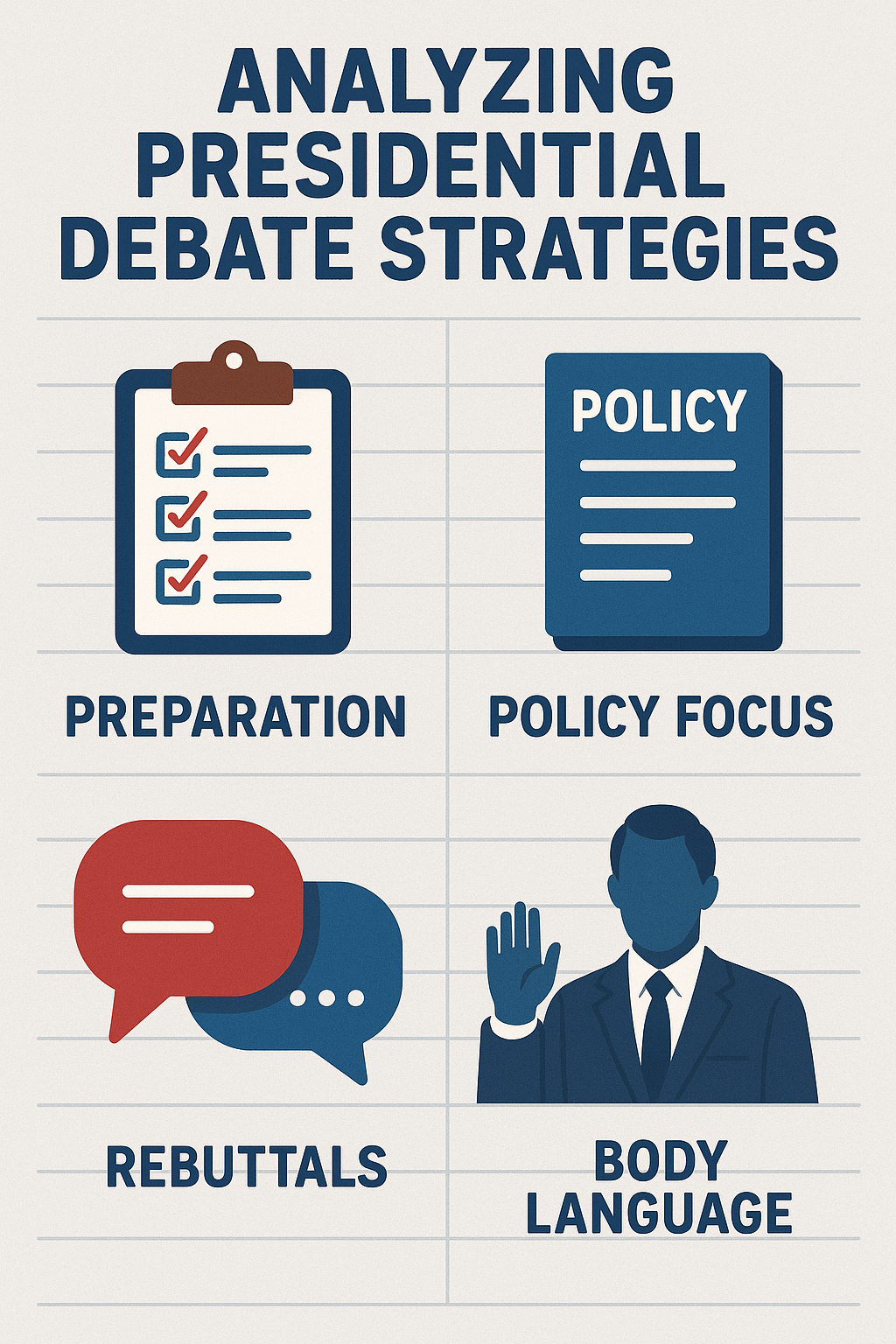
Presidential debates are political theater wrapped in strategy. Every pause, pivot, smile, statistic, accusation, and deflection has been rehearsed by teams of advisors who treat persuasion like a science. When candidates walk onto that stage, they’re not improvising. They’re executing a blueprint designed to win the moment, shape headlines, and tilt undecided voters.
This guide breaks down the strategic machinery behind presidential debates so you can watch — or participate in — high‑stakes arguments with a sharper, more tactical eye.
Why Debate Strategy Matters
A presidential debate isn’t about scoring perfect answers. It’s about:
Controlling the story
Creating emotional resonance
Delivering memorable moments
Deflecting weaknesses
Exposing opponent vulnerabilities
In elections decided by thin margins, debate strategy becomes a powerful tool for shaping perception.
The Core Strategies Candidates Use on Stage
The Message Triangle
Every candidate enters with three core talking points. No matter the question, they redirect — gracefully or bluntly — back to one of the three.
This creates:
Message consistency
Media‑friendly clips
A sense of clarity and discipline
It’s strategic repetition disguised as spontaneity.
The Pivot
When faced with difficult questions, candidates execute a pivot: acknowledging the topic briefly, then steering toward their intended message.
A classic pivot pattern:
Brief acknowledgment
Quick reframing
Redirect to core message
A pivot isn’t evasion. It’s narrative navigation.
Pre‑Emptive Framing
Candidates attempt to define their opponent before their opponent defines themselves.
This often appears as:
Labeling (“My opponent’s plan is unrealistic…”)
Pre‑empting attacks before they're delivered
Box‑building: limiting an opponent’s possible responses
The earlier a candidate frames their opponent, the harder that opponent must work to break out of the mold.
The Attack and Counter‑Attack Cycle
Attacks are designed to:
Create doubt
Break confidence
Force defensive posture
Counters are crafted to:
Flip blame
Reframe the issue
Demonstrate composure
The winner is often the one who stays offensive without seeming abrasive.
Emotional Tone Control
Presidential debates aren’t judged only on logic. They’re judged on vibe.
Candidates carefully manage tone to appear:
Confident
Compassionate
Commanding
Unflappable
Tone often decides audience perception before the content does.
Strategic Use of Facts, Figures, and Stories
Data as Armor
Statistics and evidence create an aura of competence.
Candidates use:
Economic metrics
Crime statistics
Policy projections
Historical comparisons
Even when selective, data signals seriousness.
Storytelling for Emotional Impact
A single compelling story can eclipse ten minutes of policy detail.
Presidential candidates use:
Personal anecdotes
Voter stories from the campaign trail
Symbolic narratives
Stories bypass analysis and go straight to the emotional center.
The "Call to Vision"
Every debate includes moments where candidates shift from policy to vision.
A vision answer:
Elevates the tone
Creates inspiration
Makes the candidate seem bigger than the moment
Vision plays especially well with undecided voters.
Rhetorical Tactics that Shape Debate Outcomes
Contrast Statements
These sharpen distinctions:
"I stand for X. My opponent stands for Y."
"We look forward. They look backward."
Contrast is clarity. It draws ideological battle lines.
Loaded Questions and Traps
Candidates sometimes embed traps in their responses, forcing opponents into:
Defensive clarifications
Unpopular admissions
Appearing evasive
A well‑placed trap can dominate post‑debate headlines.
The Strategic Pause
Silence becomes a tool:
It emphasizes key points
Forces the opponent to fill space
Signals confidence
The quiet moments often carry the most gravity.
How Moderators Influence Debate Strategy
Moderators subtly guide the entire debate.
Their influence appears through:
Question framing
Follow‑up pressure
Enforcing time limits
Fact‑checking roles
A candidate’s ability to adapt to moderator style can shift the debate’s direction.
The Aftermath Strategy: Winning the Post‑Debate Narrative
Debates don’t end when the cameras cut. Campaigns immediately push:
Highlight clips
Spin room arguments
Talking points for surrogates
Social media narratives
Winning the debate sometimes matters less than winning the interpretation of the debate.
Conclusion
Presidential debate strategy is a dance of structure, psychology, rhetoric, and performance. Once you recognize the patterns behind each move, debates stop feeling chaotic and start revealing themselves as meticulously crafted battles for public belief.
This insight equips you to analyze debates more critically — and to apply similar strategic elements in your own arguments on Argufight.
Related articles
Should College Athletes Receive a Share of Athletic Revenue?
Debate over whether student‑athletes deserve a cut of the billions generated by college sports.
Human vs. Debate AI: Can an Algorithm Truly Judge an Argument?
Debate AI promises speed and objectivity, but can it truly grasp nuance and persuasion? This post explores ArguFight’s algorithm, its strengths, limits, and why a hybrid human‑AI approach may be the future of fair judging.
How to Use Debate AI to Master Rebuttals, Logic, and Persuasion
Learn how to harness ArguFight’s Debate AI to craft razor‑sharp rebuttals, strengthen logical structure, and boost persuasive power. From evidence sourcing to real‑time feedback loops, this guide shows you step‑by‑step techniques for mastering debate.