How AI Judges Evaluate Your Arguments: Inside the Algorithm
As artificial intelligence increasingly enters classrooms, competitions, hiring processes, and online platforms, a new question is reshaping debate and argumentation: How does an AI judge actually evaluate your arguments? This article pulls back the curtain on AI-driven evaluation systems, explaining how algorithms assess logic, evidence, clarity, bias, and persuasion—and what that means for anyone trying to argue effectively in an age of machine judgment.
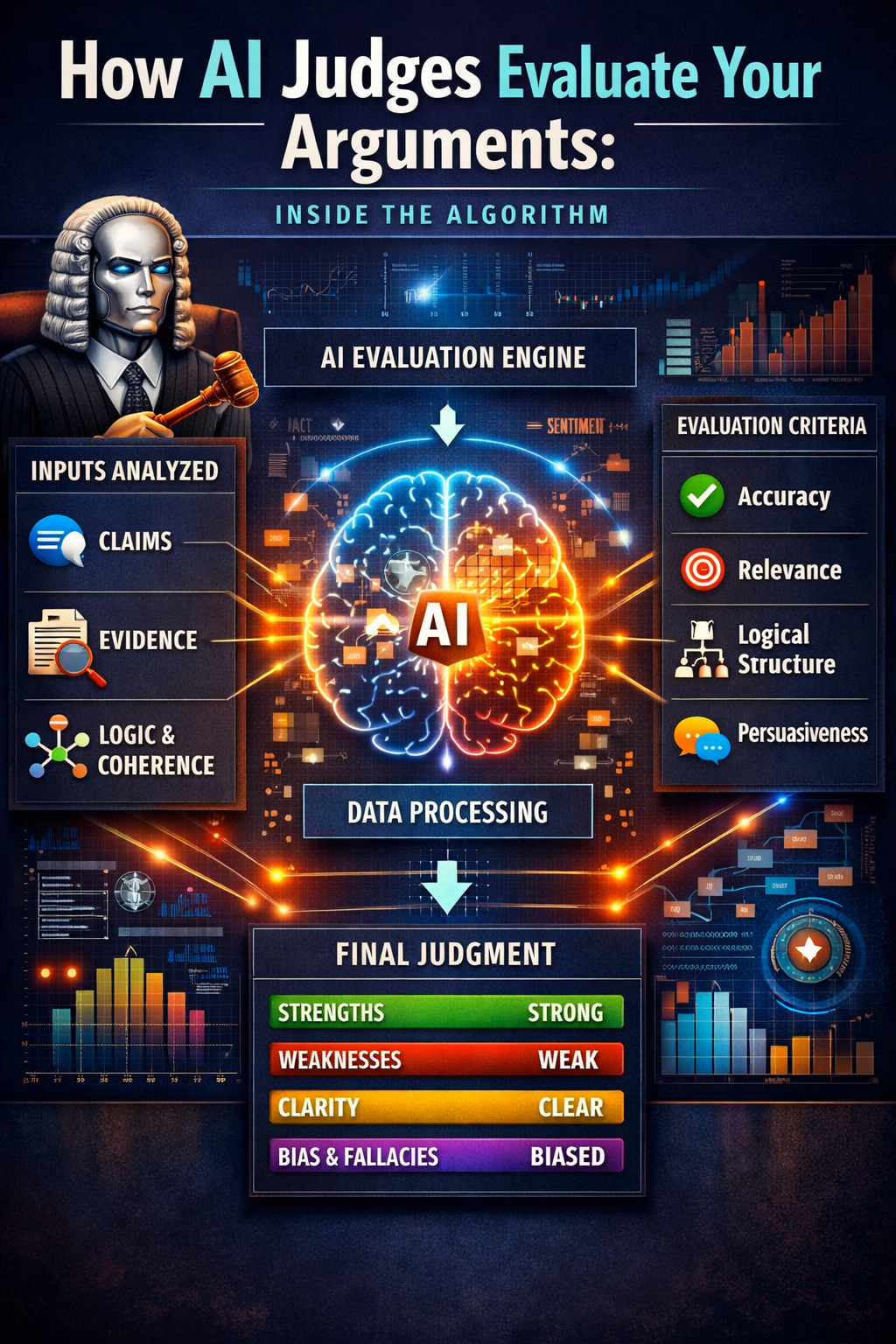
Introduction: When the Judge Is an Algorithm
Imagine finishing a debate, essay, or policy proposal—only to learn that your work won’t be evaluated by a human judge, teacher, or panel, but by an algorithm. This is no longer science fiction. AI systems already assess student essays, moderate online arguments, rank debate performances, screen job applications, and even assist in legal and policy analysis.
For many speakers and writers, this raises a troubling question: Can an algorithm really understand an argument? The answer is both yes and no. AI judges do not “understand” arguments the way humans do, but they evaluate them using sophisticated models trained on millions of examples of reasoning, language patterns, and decision outcomes.
Understanding how AI judges evaluate arguments is becoming a competitive advantage. Whether you’re a student, debater, professional communicator, or content creator, knowing what the algorithm looks for—and what it penalizes—can dramatically affect your scores, rankings, and outcomes.
This article takes you inside the algorithm. We’ll explore how AI systems break arguments down into components, how they score logic and evidence, where bias and limitations come into play, and how you can adapt your argumentation style without sacrificing intellectual integrity.
1. What Is an AI Judge, Really?
An “AI judge” is not a single program but a category of systems designed to evaluate arguments, reasoning, or persuasive content. These systems may be used in debate platforms, educational grading tools, hiring assessments, moderation systems, or decision-support software.
At their core, AI judges rely on:
Natural Language Processing (NLP) to interpret text or speech
Machine learning models trained on large datasets of arguments and evaluations
Scoring frameworks that translate qualitative features into quantitative metrics
Rather than asking whether an argument is true, AI judges usually ask whether it is well-formed according to predefined criteria. These criteria often mirror human rubrics—but they are applied mechanically, consistently, and at scale.
This distinction matters. AI judges reward structure, clarity, and recognizable patterns of good reasoning, sometimes even when the underlying idea is controversial or unconventional.
2. Argument Decomposition: How AI Breaks Your Case Apart
The first thing an AI judge does is break your argument into parts. This process is called argument decomposition.
Most systems attempt to identify:
Claims or conclusions
Supporting premises
Evidence or examples
Logical connectors (because, therefore, however)
Arguments that clearly separate these elements score higher because they are easier for algorithms to parse. Dense, poetic, or highly implicit reasoning often performs worse—not because it’s weak, but because it’s harder for the system to recognize.
For example, an argument that explicitly states, “My claim is X. This is supported by evidence Y, which leads to conclusion Z,” aligns well with AI parsing models. In contrast, arguments that rely on rhetorical flourish or implied logic risk being under-credited.
In short, AI judges prefer explicit reasoning over elegant ambiguity.
3. Logical Consistency: The Algorithm’s Obsession
One of the strongest signals AI judges look for is logical consistency. Algorithms are exceptionally good at spotting internal contradictions, circular reasoning, and non sequiturs.
AI systems evaluate whether:
Conclusions follow from premises
Claims remain stable throughout the argument
Definitions are used consistently
If you argue early that a policy is ineffective and later praise its success without explanation, an AI judge is likely to flag this inconsistency—even if a human judge might overlook it in a fast-paced setting.
However, AI systems are less forgiving of nuanced shifts in position. Strategic concessions or evolving arguments must be clearly signposted, or the algorithm may interpret them as contradictions.
For AI judges, clarity is not optional—it is essential.
4. Evidence Recognition and Weighting
Evidence plays a central role in AI-based evaluation, but not all evidence is treated equally. Algorithms are trained to recognize certain signals of credibility.
Common evidence markers include:
Statistics and numerical data
References to studies, institutions, or reports
Cause-and-effect explanations
AI judges often score arguments higher when evidence is explicitly linked to claims. Merely listing facts without explaining relevance can reduce effectiveness.
That said, AI systems may struggle to evaluate quality in the human sense. A weak study cited clearly may score better than a strong but vaguely referenced insight. This creates a subtle incentive to over-structure evidence presentation.
The takeaway: Explain not just what your evidence is, but what it proves.
5. Language Clarity, Precision, and Readability
AI judges are highly sensitive to language patterns. Clarity, grammar, and sentence structure significantly affect evaluation scores.
Key factors include:
Readability metrics
Sentence coherence
Vocabulary consistency
Overly complex sentences can confuse parsing models, while excessively simple language may signal low analytical depth. The sweet spot is precise, moderately complex, and well-organized prose.
Importantly, AI judges are less impressed by rhetorical aggression. Insults, sarcasm, or emotionally charged language often reduce clarity scores and can trigger moderation penalties.
When writing or speaking for AI evaluation, think less like a performer and more like an engineer of meaning.
6. Bias Detection and Ethical Filters
Modern AI judges increasingly incorporate bias detection and ethical safeguards. These systems scan arguments for:
Discriminatory language
Harmful generalizations
Incitement or exclusionary framing
Even when bias is discussed critically, unclear phrasing can trigger penalties. Context matters—but algorithms sometimes struggle to distinguish endorsement from analysis.
As a result, careful framing is essential. Explicitly signaling intent—such as critiquing a biased viewpoint rather than promoting it—helps prevent misclassification.
AI judges are not moral agents, but they enforce moral constraints embedded by designers.
7. Persuasion vs. Explanation: What AI Rewards
Human judges are often swayed by charisma, humor, or emotional resonance. AI judges are not.
Algorithms tend to reward:
Coherent explanation over emotional appeal
Justified reasoning over rhetorical force
Balanced tone over adversarial framing
This doesn’t mean persuasion is irrelevant. Instead, persuasion must be encoded as reasonableness. Arguments that acknowledge counterpoints, address objections, and explain trade-offs tend to score higher.
Ironically, AI judges often favor arguments that sound less like debates and more like analytical essays.
8. Structural Signals and Formatting Cues
AI systems pay close attention to structure. Headings, transitions, paragraph breaks, and logical sequencing all improve evaluation outcomes.
Clear structure helps algorithms:
Track argument progression
Identify major claims
Assign scores accurately
Poorly structured arguments may be penalized even if the ideas themselves are strong. This is especially true in written formats, where layout and organization are machine-readable signals.
Structure is not cosmetic—it is computationally meaningful.
9. Where AI Judges Fall Short
Despite their power, AI judges have serious limitations.
They often struggle with:
Original or unconventional reasoning
Deep moral philosophy
Cultural nuance and irony
Long-term implications beyond training data
AI judges reward familiarity. Arguments that resemble previously successful patterns tend to score higher than radically new ideas. This creates a risk of intellectual conformity.
Human judgment remains essential for evaluating creativity, wisdom, and ethical depth.
10. How to Optimize Your Arguments for AI—Without Selling Your Soul
Optimizing for AI does not mean abandoning good thinking. It means making your reasoning legible.
Practical strategies include:
State claims explicitly
Link evidence directly to conclusions
Define key terms clearly
Signal transitions and concessions
Maintain consistent terminology
Think of AI judges as extremely literal readers. They reward transparency, not trickery.
Conclusion: Arguing in the Age of Machine Judgment
AI judges are not replacing human judgment—but they are reshaping the standards by which arguments are evaluated. Understanding how algorithms assess logic, evidence, clarity, and tone allows you to adapt strategically while preserving intellectual honesty.
The future of argumentation will belong to those who can persuade both humans and machines. By learning to think clearly, structure explicitly, and reason rigorously, you don’t just score better—you future-proof your voice in an increasingly algorithmic world.
Inside the algorithm, clarity is king—and good arguments still matter.
Related articles
Should College Athletes Receive a Share of Athletic Revenue?
Debate over whether student‑athletes deserve a cut of the billions generated by college sports.
Human vs. Debate AI: Can an Algorithm Truly Judge an Argument?
Debate AI promises speed and objectivity, but can it truly grasp nuance and persuasion? This post explores ArguFight’s algorithm, its strengths, limits, and why a hybrid human‑AI approach may be the future of fair judging.
How to Use Debate AI to Master Rebuttals, Logic, and Persuasion
Learn how to harness ArguFight’s Debate AI to craft razor‑sharp rebuttals, strengthen logical structure, and boost persuasive power. From evidence sourcing to real‑time feedback loops, this guide shows you step‑by‑step techniques for mastering debate.