How to Cite Sources in Online Debates (The Right Way)
Learn how to cite sources in online debates with simple formats, credible references, and examples. Boost your argument quality and win more debates.
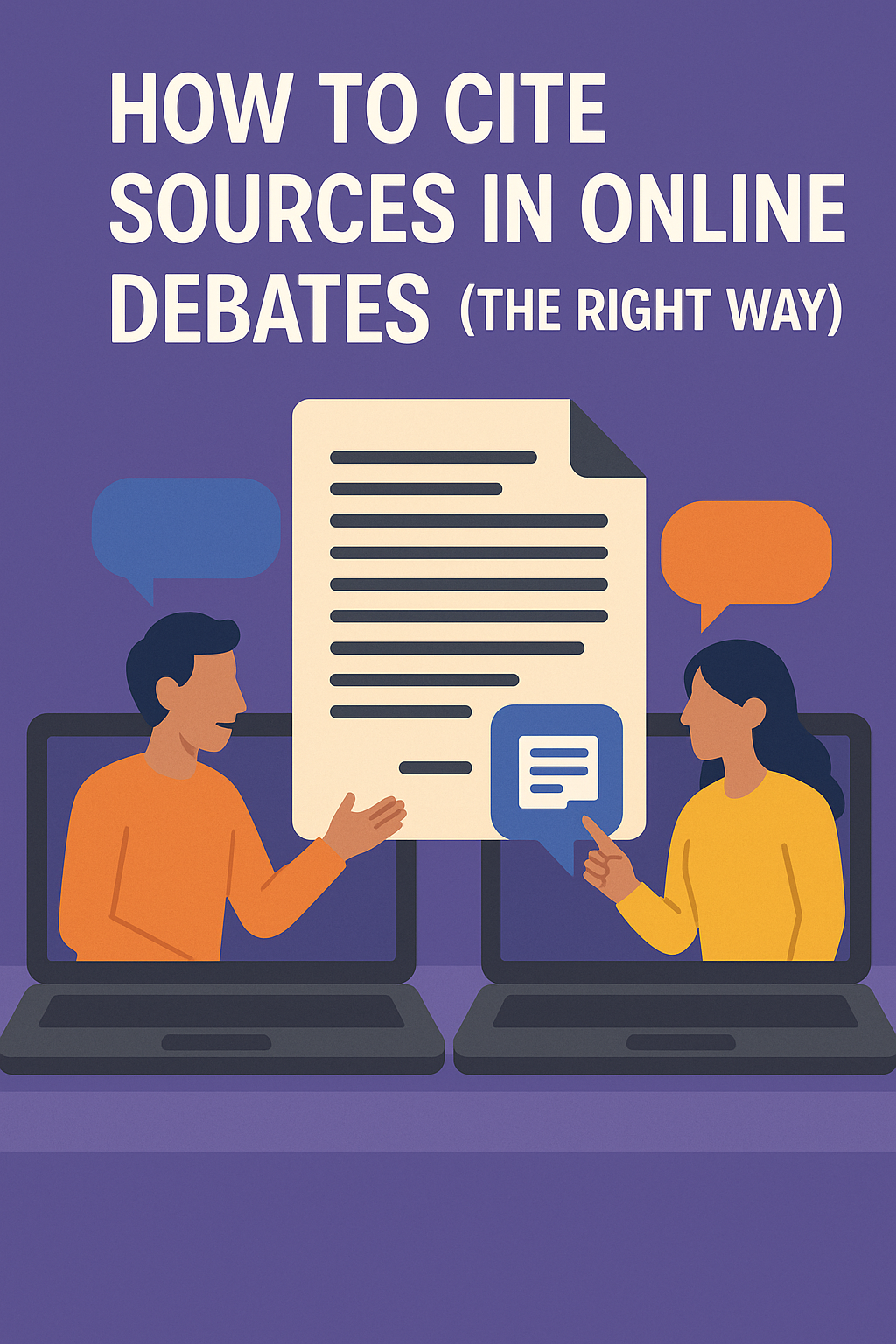
In online debates—whether on Argufight, Reddit, X, or any social media platform—your evidence is your credibility. Strong claims without credible sources get dismissed, ignored, or attacked. But when you cite properly, your argument becomes more persuasive, professional, and harder to refute.
This guide breaks down how to cite sources online, the best formats, credible reference types, common mistakes, and plug‑and‑play examples you can use immediately.
Why Citing Sources Matters in Online Debates
Citing sources does more than show where your information came from—it strengthens every point you make.
1. It boosts credibility
People trust arguments backed by data, studies, experts, and reputable organizations.
2. It protects you from being fact‑checked
If someone challenges your point, you already have the receipt.
3. It forces your opponent to argue with evidence—not emotion
Good sources shift the debate into logic and research, where strong reasoning wins.
4. It improves the overall debate quality
Clear, reliable citations encourage productive, evidence‑based conversation.
The 5 Types of Credible Sources You Should Use
Not all sources are created equal. In debates, credibility matters more than convenience.
1. Peer-reviewed academic studies
Examples: PubMed, JSTOR, Google Scholar.
2. Government or institutional data
Examples: Census Bureau, WHO, UN, CDC.
3. Reputable news organizations
Examples: Reuters, Associated Press, BBC.
4. Books by recognized experts
Especially when the author is credentialed in the topic.
5. Industry reports and white papers
Examples: McKinsey, Deloitte, Pew Research.
Avoid sources like personal blogs, random social media posts, or AI‑generated claims without citations.
Simple Citation Formats for Online Debates
You don’t need MLA, APA, or Chicago style for social media. What you need is:
Source name
Author (optional)
Date (if relevant)
Direct link to the page
Here are the best formats for quick online citation:
Format 1: Short and clean
Source: Pew Research (2023) – link
Format 2: Full but simple
Pew Research Center (2023). "Trends in Social Media Usage."
https://www.pewresearch.org/...
Format 3: Claim + source
"76% of adults use online platforms for news." — Pew Research (2023)
link
Format 4: Screenshot evidence
If the platform allows images, show a snippet + link.
Format 5: Citation clusters
Useful for large claims:
According to CDC (2022), WHO (2023), and two peer-reviewed studies (PubMed links), the data consistently shows…
How to Insert Citations Naturally in a Debate
Citing shouldn’t break the flow of your argument. Use these patterns:
1. The Lead‑In
"According to…"
2. The Support Statement
"This is supported by data from…"
3. The Evidence Punch
Drop the link at the end of your paragraph.
4. The Rebuttal Evidence
"Your claim contradicts findings from…"
5. The Question Citation
Use it strategically to force your opponent to support their claims:
"Do you have any sources stronger than the CDC report I just provided?"
Common Citation Mistakes to Avoid
1. Linking to videos instead of sources
Videos often contain commentary, not data.
2. Using biased sources
Example: political blogs, advocacy groups.
3. Cherry-picking data
Your opponent will spot it.
4. Using outdated information
If your claim is from 2010 and the world has changed drastically since, update it.
5. Dropping walls of links
Use only relevant, high-quality citations.
Examples of Properly Cited Debate Arguments
Example 1: Social Issue
"Studies show that early childhood education increases lifetime earnings by up to 16%. — Brookings Institution (2022)"
Example 2: Health Claim
"The CDC (2023) confirms that the current recommended vaccination schedule has a 99% effectiveness rate."
Example 3: Economic Argument
"U.S. inflation slowed to 3.1% in 2024, based on data from the Bureau of Labor Statistics."
Example 4: Technology Claim
"AI adoption increased 2x between 2022–2024 — McKinsey Global Report (2024)."
Recommended Tools for Quick Citation Generation
Google Scholar (auto‑generated citations)
ZoteroBib (fast citation formatting)
Perplexity.ai (source-backed queries)
Statista (industry data)
Pew Research (neutral social science data)
How to Choose the Best Source for Your Claim
1. Match the source to the claim type
Scientific claim → academic study
Economic claim → government data
Social trend → Pew or Gallup
2. Prioritize objectivity
Avoid ideological sites.
3. Check the publication date
If the topic changes fast (tech, health), use <3 years old.
4. Look for consensus, not outliers
Multiple agreeing sources are stronger than one extreme one.
How Many Sources Should You Use Per Argument?
A good baseline:
1–2 sources per major claim
3 sources for high‑stakes claims
5+ sources only for comprehensive debates or long‑form responses
More sources ≠ stronger argument.
Quality > quantity.
Conclusion
Online debates reward those who bring receipts. When you know how to cite sources properly—cleanly, credibly, and strategically—your arguments become dramatically more persuasive. You don’t need complex academic formatting. You simply need reliable information, clear presentation, and consistent evidence.
Master these citation methods and you’ll gain authority in every debate, whether on Argufight or any other platform.
Related articles
Should College Athletes Receive a Share of Athletic Revenue?
Debate over whether student‑athletes deserve a cut of the billions generated by college sports.
Human vs. Debate AI: Can an Algorithm Truly Judge an Argument?
Debate AI promises speed and objectivity, but can it truly grasp nuance and persuasion? This post explores ArguFight’s algorithm, its strengths, limits, and why a hybrid human‑AI approach may be the future of fair judging.
How to Use Debate AI to Master Rebuttals, Logic, and Persuasion
Learn how to harness ArguFight’s Debate AI to craft razor‑sharp rebuttals, strengthen logical structure, and boost persuasive power. From evidence sourcing to real‑time feedback loops, this guide shows you step‑by‑step techniques for mastering debate.