How to Spot Logical Fallacies: Sharpen Your Debate Skills
Logical fallacies are the potholes of arguments. They make reasoning shaky, mislead audiences, and can sabotage even the strongest points. On platforms like Argufight, knowing how to spot logical fallacies turns you from a casual participant into a formidable debater.
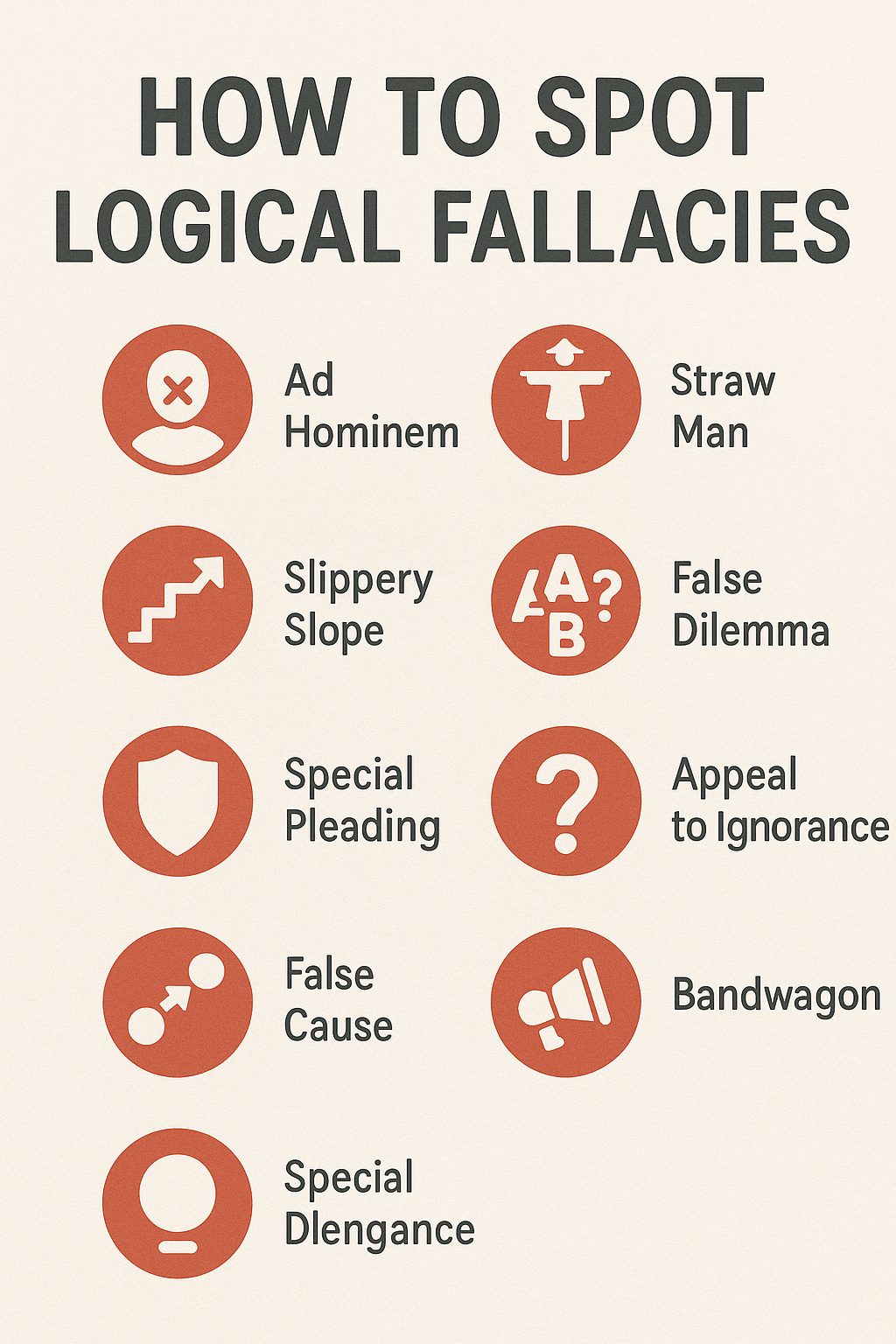
Logical fallacies are the potholes of arguments. They make reasoning shaky, mislead audiences, and can sabotage even the strongest points. On platforms like Argufight, knowing how to spot logical fallacies turns you from a casual participant into a formidable debater. This guide breaks down the most common fallacies, how they appear, and how to counter them effectively.
What Is a Logical Fallacy?
A logical fallacy is an error in reasoning that weakens an argument. Fallacies often look convincing but fail under scrutiny. Understanding them equips you to:
Identify flawed reasoning
Counter arguments without attacking individuals
Build stronger, evidence-based positions
Common Logical Fallacies
1. Ad Hominem
Attacking the person instead of the argument.
Example: "You can’t trust her argument on climate change; she’s not a scientist."
Counter: Focus on the claim, not the individual.
2. Strawman
Misrepresenting an argument to make it easier to attack.
Example: "He wants more funding for schools, so he must want to bankrupt the state."
Counter: Restate the original argument accurately before responding.
3. Appeal to Authority
Believing a claim is true because an authority said so.
Example: "The celebrity says this diet works, so it must be true."
Counter: Check evidence, not credentials alone.
4. Slippery Slope
Arguing that one event will inevitably lead to a series of extreme outcomes.
Example: "If we allow X, soon everything will collapse."
Counter: Ask for evidence linking each step.
5. False Dilemma
Presenting two options as the only possibilities.
Example: "You’re either with us or against us."
Counter: Highlight the spectrum of alternatives.
6. Circular Reasoning
The argument repeats itself without providing new evidence.
Example: "I’m trustworthy because I say I am."
Counter: Request independent support.
7. Hasty Generalization
Drawing broad conclusions from limited data.
Example: "My two friends failed math; school must be terrible."
Counter: Ask for larger, representative samples.
8. Post Hoc
Assuming causation from correlation.
Example: "I wore my lucky socks and won, so the socks caused the win."
Counter: Seek other explanations.
9. Red Herring
Introducing irrelevant information to distract.
Example: "Why worry about pollution when there’s crime?"
Counter: Redirect focus to the original argument.
10. Appeal to Emotion
Using emotions instead of logic.
Example: "You should vote for me because it would break my heart if I lost."
Counter: Evaluate the argument on evidence.
Strategies to Spot Fallacies
Listen carefully: Note whether the argument addresses the main point.
Question assumptions: Are there hidden leaps in reasoning?
Check evidence: Is there proof, or just opinion?
Look for exaggeration: Extreme claims often signal fallacies.
Separate person from point: Avoid getting drawn into ad hominem traps.
Applying This Knowledge in Debates
Pause before reacting to spot fallacies.
Ask clarifying questions.
Respond to the argument, not the misdirection.
Educate rather than belittle opponents.
Build your own argument free from fallacies.
Conclusion
Mastering how to spot logical fallacies makes you a more critical thinker and a more persuasive debater. You learn to cut through noise, challenge weak reasoning, and strengthen your own arguments. In the fast-paced world of online debate, this skill is your intellectual superpower.
Related articles
Should College Athletes Receive a Share of Athletic Revenue?
Debate over whether student‑athletes deserve a cut of the billions generated by college sports.
Human vs. Debate AI: Can an Algorithm Truly Judge an Argument?
Debate AI promises speed and objectivity, but can it truly grasp nuance and persuasion? This post explores ArguFight’s algorithm, its strengths, limits, and why a hybrid human‑AI approach may be the future of fair judging.
How to Use Debate AI to Master Rebuttals, Logic, and Persuasion
Learn how to harness ArguFight’s Debate AI to craft razor‑sharp rebuttals, strengthen logical structure, and boost persuasive power. From evidence sourcing to real‑time feedback loops, this guide shows you step‑by‑step techniques for mastering debate.