How to Win Any Debate: 10 Proven Tactics
Learn how to win a debate with 10 proven tactics backed by logic, persuasion, and strategy. Master openings, rebuttals, and evidence.
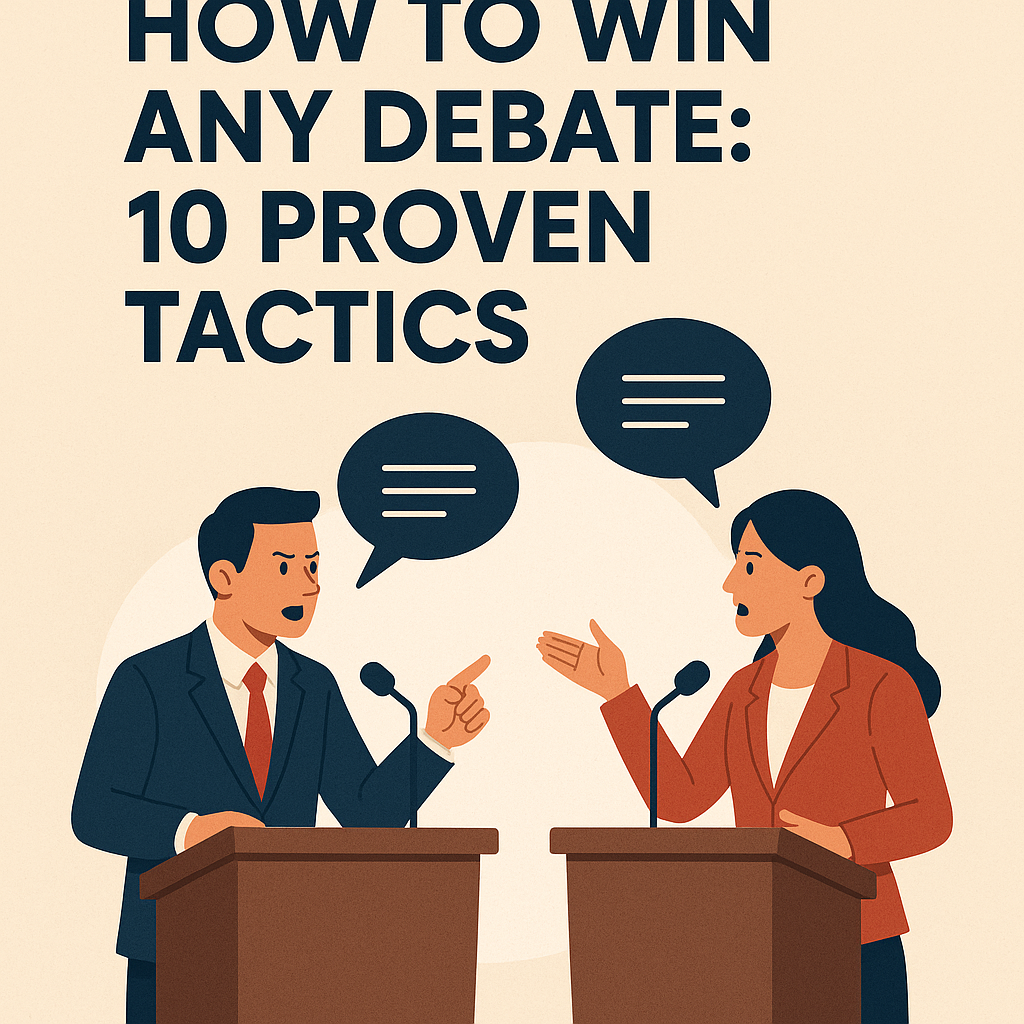
Winning a debate isn’t just about speaking louder or having the most confidence. It’s about using strategy, structure, logic, persuasion, psychology, and timing. Whether you’re debating online on platforms like ArguFight, in a classroom, or in a boardroom, the techniques below will help you win more arguments with clarity—and without unnecessary conflict.
Below you’ll find 10 proven debate tactics, how to use them, when to deploy them, and examples you can immediately apply.
1. Establish a Clear Claim Early
Your first task in any debate is simple: make your position unmistakably clear. A well-defined claim serves as the anchor for everything that follows.
Why it works: Clear claims are easier to defend and harder to misrepresent.
Example:
"My position is that universal basic income increases economic stability for low-income households."
Tips:
Avoid vague language.
Define key terms.
Predict possible ambiguities and clarify them upfront.
2. Use Structured Arguments (The ACE Framework)
Winning debaters rely on structure. One of the most effective structures is ACE:
Assert your point
Cite evidence
Explain why it matters
Example: Assert: "Remote work increases productivity." Cite: "A Stanford study found a 13% productivity boost in remote workers." Explain: "This matters because companies adopting remote policies can gain measurable performance increases."
3. Reinforce Your Argument With Evidence
Evidence separates opinions from defensible positions. Use:
Peer-reviewed studies
Historical data
Expert testimony
Logical evidence (e.g., if/then logic)
Case studies
Tip: In online debates, link directly to your source for credibility.
Common mistake: Using too many weak sources instead of a few strong ones.
4. Anticipate and Preempt Objections
One of the smartest ways to defeat a rebuttal is to address it before your opponent brings it up.
Why it works: It shows you’ve thought deeply and prevents them from using their strongest counter.
Example:
"Some argue UBI discourages people from working, but studies from Finland show employment levels were largely unchanged."
5. Maintain Logical Consistency
Logic wins debates. Emotion wins attention. The best debaters use both strategically.
Avoid logical fallacies such as:
Strawman arguments
Ad hominem attacks
False dilemmas
Slippery slopes
Circular reasoning
6. Use Strategic Questioning (But Don’t Be Manipulative)
Questions force clarity.
Types of questions:
Clarifying questions: “What do you mean by…?”
Exposure questions: “If your argument is true, how do you explain…?”
Limit-testing questions: “Does your claim apply in all cases or only some?”
Why it works: It forces the other side to commit to specifics.
Control the Framing of the Debate
Framing = the lens through which the debate is evaluated. Control the frame, and you often control the outcome.
Example: Instead of debating whether remote work is good or bad, reframe it as:
"The real question is whether companies benefit more from flexibility or rigidity."
Frames influence the criteria for judgment.
8. Deliver Powerful Rebuttals
A weak rebuttal can undo a strong argument. Focus on:
Targeting their strongest point—not the easiest one.
Using evidence to invalidate their premise.
Showing contradictions.
Refuting assumptions.
Rebuttal formula:
Identify the claim.
Explain why it's flawed.
Provide a counterexample or evidence.
Restate your original position.
9. Use Persuasive Communication Techniques
Even the best logic fails if delivered poorly. Improve your delivery with:
Concise language (cut filler words)
Confident tone (avoid rising intonation)
Parallel structure (patterns help retention)
Vivid examples (engage imagination)
Example:
"This policy is practical, affordable, and proven."
10. Close With a Strong Summary
The ending determines what the audience remembers.
A strong close includes:
Restatement of your thesis
The 2–3 strongest pieces of evidence
A final persuasive insight
Example:
"The evidence shows UBI increases stability, improves health outcomes, and requires no additional taxation. The data is clear: people—and economies—perform better with a safety net."
Conclusion
Winning a debate isn’t luck—it’s preparation, strategy, clarity, and execution. By applying these 10 proven tactics, you’ll be able to construct stronger arguments, anticipate counterpoints, and persuade your audience more effectively in any setting.
If you’re ready to sharpen your skills in real conversations, practice these tactics on ArguFight, where structured argument meets intelligent dialogue.
Related articles
Should College Athletes Receive a Share of Athletic Revenue?
Debate over whether student‑athletes deserve a cut of the billions generated by college sports.
Human vs. Debate AI: Can an Algorithm Truly Judge an Argument?
Debate AI promises speed and objectivity, but can it truly grasp nuance and persuasion? This post explores ArguFight’s algorithm, its strengths, limits, and why a hybrid human‑AI approach may be the future of fair judging.
How to Use Debate AI to Master Rebuttals, Logic, and Persuasion
Learn how to harness ArguFight’s Debate AI to craft razor‑sharp rebuttals, strengthen logical structure, and boost persuasive power. From evidence sourcing to real‑time feedback loops, this guide shows you step‑by‑step techniques for mastering debate.