How to Win Debates When You’re Wrong: The Art of Defense
In competitive debating, you won’t always defend the stronger side of an issue. Sometimes, you’re assigned a position that’s unpopular, counterintuitive, or even factually weaker. This guide explores how skilled debaters still win under those conditions—by mastering defensive strategy, reframing burdens, and arguing persuasively even when the odds are against them.
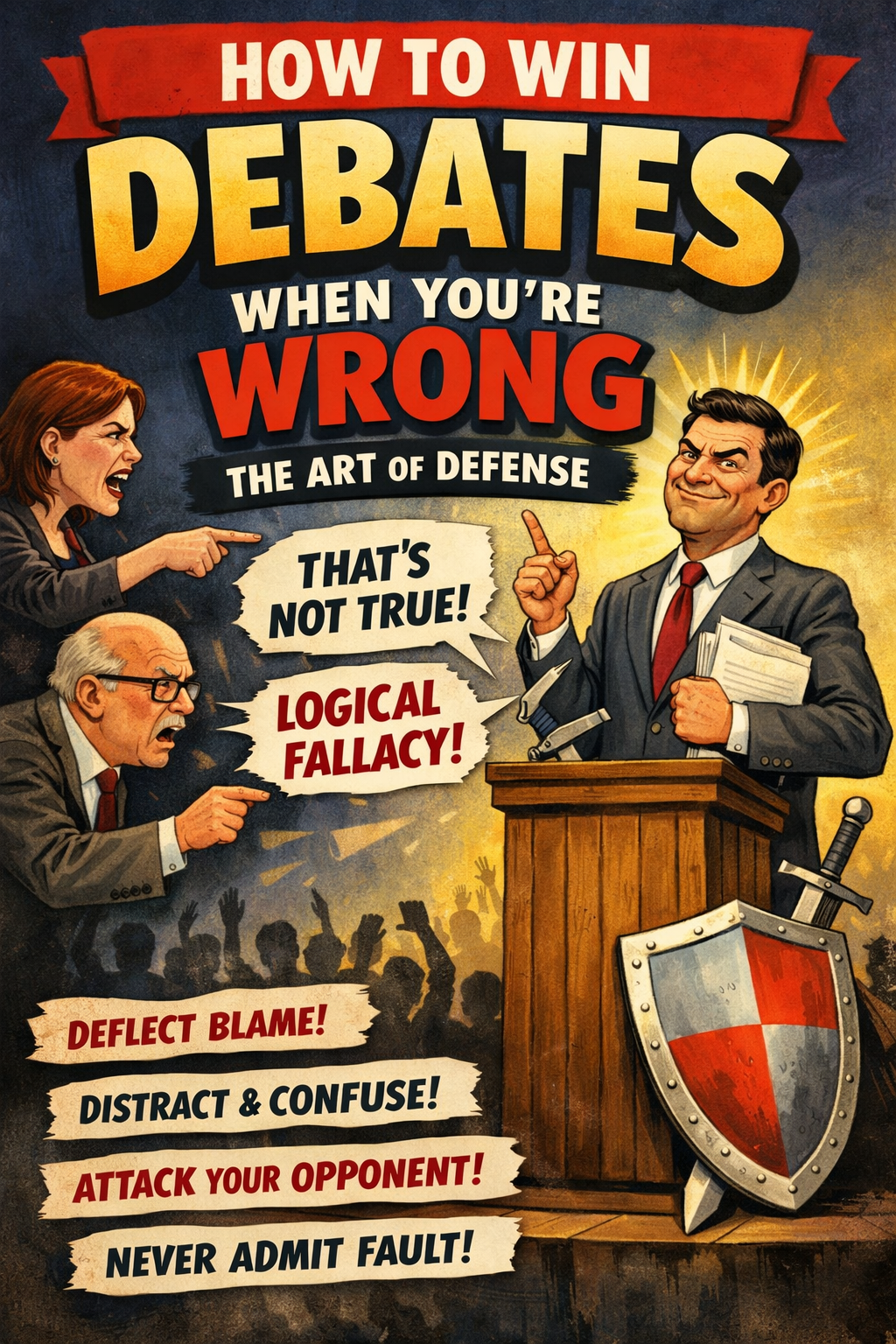
The Uncomfortable Reality of Competitive Debate
Every debater eventually faces an uncomfortable truth: you won’t always be on the “right” side. In many formats, positions are assigned randomly. In others, you may be forced to defend a policy, principle, or interpretation you personally disagree with—or one that seems clearly weaker than its alternative.
Beginners often panic in these situations. They assume that if the facts, morality, or public opinion favor the other side, losing is inevitable. Experienced debaters know better.
Competitive debate is not about discovering absolute truth. It is about persuasion under rules. Judges evaluate how well you defend a position relative to the standards of the round, not whether history will ultimately vindicate you. This is where the art of defense becomes decisive.
This article explains how debaters win rounds even when their position is wrong, unpopular, or fragile. It is not about dishonesty or manipulation. It is about understanding burdens, reframing the question, exploiting uncertainty, and forcing your opponent to do more work than they can handle.
1. First, Redefine What “Wrong” Means in Debate
In everyday life, being wrong means holding a false belief. In debate, being “wrong” usually means one of three things:
Your position is counterintuitive or unpopular
Your side has weaker empirical support
Your opponent’s case feels morally superior
None of these automatically lose you the round.
Debate outcomes depend on comparative justification. Judges ask which side better met its burdens, not which side aligned with common sense or personal beliefs.
Once you stop treating “wrong” as fatal, you unlock strategic flexibility.
2. Master the Burden of Proof
One of the most powerful defensive tools is understanding—and manipulating—the burden of proof.
In most debates:
The affirmative must prove the motion true or desirable
The negative must show that the affirmative failed to meet that burden
If you are defending a weak position, your goal is often not to prove your case beyond doubt, but to prevent your opponent from proving theirs.
Strategies include:
Demanding clear causal mechanisms
Questioning feasibility or implementation
Highlighting missing evidence
If the affirmative cannot meet its burden, you can win without offering a perfect alternative.
Defense wins debates by making certainty impossible.
3. Narrow the Resolution Aggressively
Weak positions collapse when they are argued too broadly. Strong defenders narrow the scope of the debate.
This involves:
Interpreting the motion in the most defensible way
Limiting timeframes, populations, or conditions
Focusing on edge cases where your side performs better
For example, instead of defending a policy universally, you may defend it as:
A temporary measure
A last resort
Applicable only under specific conditions
Judges often reward reasonable interpretations, especially if your opponent fails to challenge them effectively.
Control the scope, and you control the battlefield.
4. Reframe the Metric of Winning
When your side is substantively weak, change how success is measured.
If your opponent argues outcomes, you can argue:
Risk management
Moral thresholds
Institutional stability
Long-term uncertainty
For instance, instead of claiming a policy produces the best results, argue that it avoids catastrophic risks—even if it’s imperfect.
Debates are won by comparative metrics. If you choose the metric, you choose the winner.
5. Exploit Uncertainty and Complexity
Real-world issues are complex. That complexity is a gift to defensive debaters.
You can emphasize:
Conflicting evidence
Unintended consequences
Implementation gaps
Unknown long-term effects
The goal is not to deny reality, but to show that your opponent’s confidence is unjustified.
Judges are cautious about endorsing certainty where none exists. If you can make the issue seem genuinely unresolved, defense becomes offense.
6. Concede Strategically, Not Completely
One of the most advanced defensive techniques is strategic concession.
Instead of denying obvious weaknesses, acknowledge them—then minimize their importance.
Examples:
“Yes, this policy has costs, but the alternative has greater risks.”
“We agree this solution is imperfect, but perfection is not the standard.”
Strategic concessions:
Increase credibility
Reduce your opponent’s impact claims
Shift focus to comparison
Judges trust debaters who sound honest about trade-offs.
7. Turn Offense into Defense
Often, the best defense is forcing your opponent to defend their assumptions.
This can be done by:
Questioning moral premises
Challenging value hierarchies
Exposing hidden trade-offs
For example, if your opponent frames their case as morally obvious, ask what values they are sacrificing to achieve it.
When both sides appear flawed, judges compare reasoning quality—not moral comfort.
8. Win on Comparative Impact, Not Absolute Truth
Debates are rarely decided on whether something is good or bad in isolation. They are decided on comparative impact.
If your harms are smaller, less likely, or more reversible than your opponent’s, you can still win.
Defensive debaters focus on:
Probability over magnitude
Short-term certainty over long-term speculation
Manageable harms over irreversible ones
Being “less wrong” is often enough.
9. Control Tone and Judge Psychology
When defending a weak position, tone matters enormously.
Effective defensive tone is:
Calm
Reasonable
Analytical
Overconfidence invites skepticism. Aggression feels compensatory. Judges are more receptive to debaters who acknowledge difficulty while arguing thoughtfully.
You are not selling certainty—you are selling caution.
10. Know When the Goal Is Survival, Not Domination
Some rounds are not about crushing your opponent. They are about surviving their best arguments.
If you can:
Answer every major contention
Reduce impacts
Maintain internal consistency
You force judges into a close comparison—and close debates often favor disciplined defense.
Winning when you’re wrong is rarely flashy. It is methodical, controlled, and deeply strategic.
Defense Is a Skill, Not a Compromise
Learning how to win debates when you’re wrong is not about deception. It is about intellectual discipline under constraint.
The best debaters in the world are not those who only win when they are right. They are those who can defend difficult positions with clarity, fairness, and strategic insight.
By mastering burden control, reframing metrics, exploiting uncertainty, and maintaining credibility, you transform weakness into competitiveness.
In debate, truth matters—but how you defend a position often matters more. Defense is not the absence of strength. It is strength under pressure.
Related articles
Should College Athletes Receive a Share of Athletic Revenue?
Debate over whether student‑athletes deserve a cut of the billions generated by college sports.
Human vs. Debate AI: Can an Algorithm Truly Judge an Argument?
Debate AI promises speed and objectivity, but can it truly grasp nuance and persuasion? This post explores ArguFight’s algorithm, its strengths, limits, and why a hybrid human‑AI approach may be the future of fair judging.
How to Use Debate AI to Master Rebuttals, Logic, and Persuasion
Learn how to harness ArguFight’s Debate AI to craft razor‑sharp rebuttals, strengthen logical structure, and boost persuasive power. From evidence sourcing to real‑time feedback loops, this guide shows you step‑by‑step techniques for mastering debate.