Logical Fallacies to Avoid in Arguments
Learn the most common logical fallacies and how to avoid them in debates. Improve your reasoning, persuasion, and argument strength.
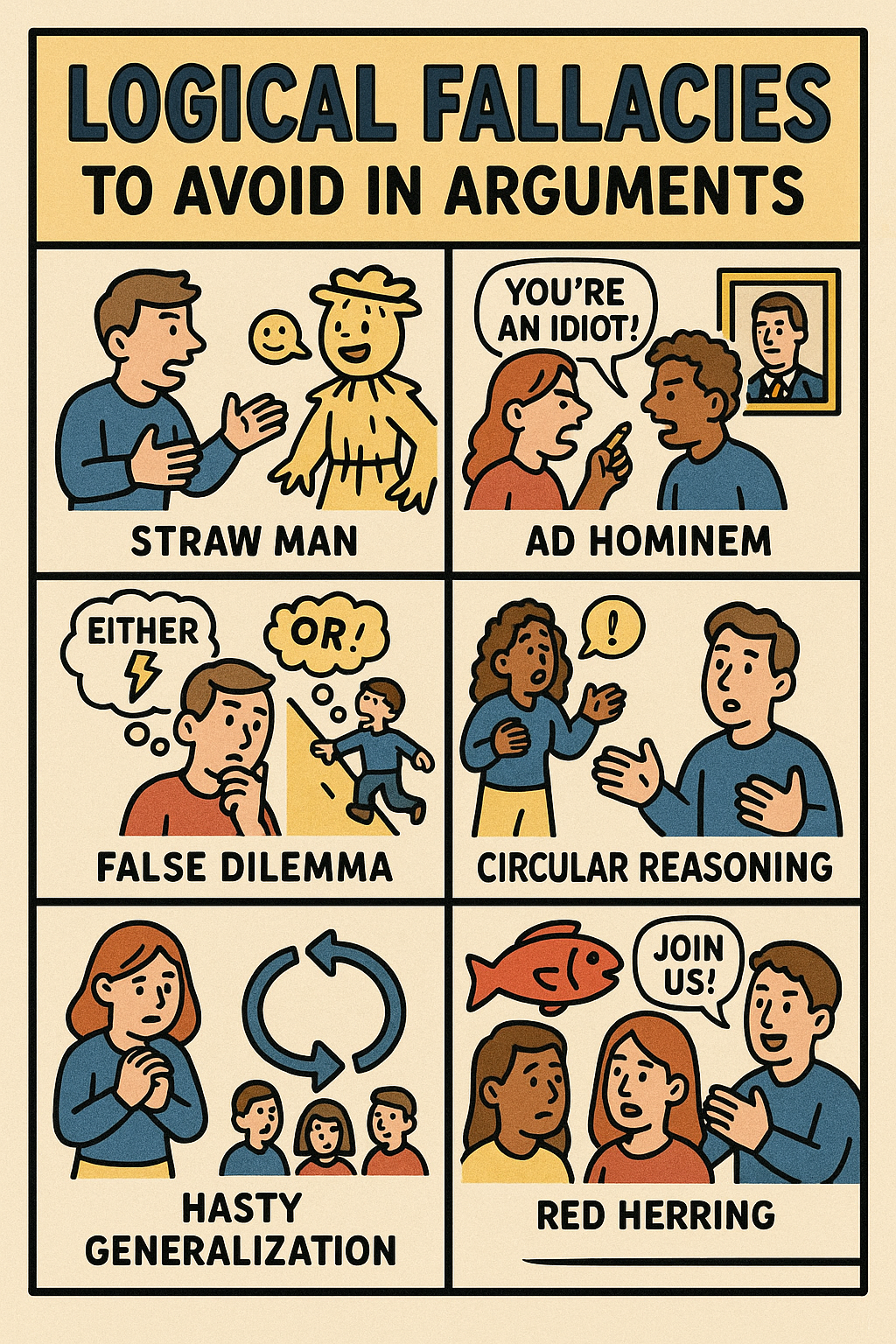
Across the last few thousand AI-judged debates on ArguFight, the same pattern keeps surfacing: the side that loses didn't lose because their position was weaker — they lost because their argument leaned on a logical fallacy at a critical moment. The AI judge flagged it. The opposing side capitalized on it. Verdict locked in.
Logical fallacies are errors in reasoning that look persuasive but break down under inspection. They're the structural cracks in an argument — sometimes deliberate, often accidental — and they're the single most common reason otherwise smart people lose debates. This guide covers the 15 fallacies our AI judges encounter most often, with concrete examples of how each one shows up in real debates, why it works on listeners psychologically, and how to dismantle it when you see it across the table from you.
Bookmark this. Whether you're climbing the ELO ladder on ArguFight, defending a position at work, or just trying to think more clearly, spotting these traps is the single highest-leverage skill in argumentation.
Why fallacies matter more than evidence
The instinctive reaction to losing an argument is "I needed better evidence." It's usually wrong. Evidence loses to bad reasoning every single time, because a strong-sounding fallacy will short-circuit your audience's evaluation before they ever inspect your data. The defender's job in any debate is to make sure that doesn't happen — to themselves, or to their opponent.
The AI judges on ArguFight score every statement on logic, evidence, and rhetoric. Logic carries the heaviest weight. A round full of well-cited evidence built on a logical fallacy will routinely score lower than a round with weaker evidence but sound reasoning. The fallacies below are, statistically, the ones that show up in the most close losses.
1. Strawman Fallacy
The Strawman misrepresents an opponent's position — usually by exaggerating it, taking it out of context, or replacing the actual claim with a weaker version that's easier to attack. The audience hears the distortion attacked, not the original argument.
Example:
Person A: "We should invest more in renewable energy infrastructure."
Person B: "So you want to shut down every oil and gas company tomorrow and put millions out of work?"
Why it works: the audience is now mentally engaging with the extreme version. Even if Person A clarifies, the distorted version is the one that emotionally lingers.
How to counter: name the move. "That's not what I argued. Let me restate my actual position: …" Repeating the original claim in plain terms reanchors the audience. Don't get drawn into defending the strawman — you'll lose ground every second you spend there.
2. Ad Hominem
Instead of engaging with the argument, the speaker attacks the person making it — their character, expertise, motives, or appearance. The implicit claim: "you can't trust the argument because you can't trust the source."
Example:
"You can't trust his argument about nutrition policy — he's overweight."
Why it works: source credibility is a legitimate factor in many real-world decisions, so the audience is primed to weigh it. The fallacy is in using it as a substitute for evaluating the argument's substance.
How to counter: "Let's set aside the speaker for a moment and look at the claim itself." Refusing to escalate personal attacks signals confidence and often makes the attacker look like they're avoiding the actual question.
3. Appeal to Authority
Citing an authority figure as the reason a claim is true, rather than the evidence the authority used to reach that conclusion. There's a subtle line: citing a domain expert who has done the work is reasonable; citing a famous name to short-circuit scrutiny is fallacious.
Example:
"This must be true — Dr. Smith says so."
Why it works: we shortcut to trusting credentials because evaluating evidence directly is hard. Authority is a useful heuristic — until it becomes a substitute for thought.
How to counter: "What evidence did Dr. Smith cite to reach that conclusion?" Push back through the authority to the underlying data. If the data is sound, the authority becomes optional.
4. False Dilemma (Either/Or)
Framing a choice as binary when more options exist. The classic political weapon: "you're either with us or against us," which erases the entire middle ground of nuanced positions.
Example:
"Either we ban encryption entirely, or terrorists win."
Why it works: binary framing reduces cognitive load. The audience has only two options to evaluate, and one is being made to look unacceptable.
How to counter: introduce the missing options explicitly. "There's a third path: targeted lawful access with judicial oversight. Why isn't that on the table?" Naming the false dichotomy out loud breaks the spell.
5. Slippery Slope
Claiming a small step will inevitably cascade into extreme consequences — without justifying the causal chain. Each link is asserted, not argued.
Example:
"If we legalize marijuana, next it'll be cocaine, then heroin, then society collapses."
Why it works: it taps into loss aversion. The audience pictures the worst outcome and works backward to reject the first step, skipping the question of whether the chain is actually plausible.
How to counter: ask for evidence on each link. "What's the empirical relationship between cannabis policy and harder-drug policy? Has it played out that way in jurisdictions that legalized?" Force the speaker to defend each step.
6. Circular Reasoning (Begging the Question)
The argument's conclusion is hidden in its premise. The reasoning appears to support the claim, but it's actually just restating the claim in different words.
Example:
"This policy is fair because it treats everyone equally — and equal treatment is what fairness means."
Why it works: it sounds rigorous because the words match. The structure looks like a syllogism. The premise smuggles in the conclusion.
How to counter: demand an independent reason. "Why is equal treatment fair? Give me a standard outside the definition itself." The fallacy collapses the moment the speaker has to leave the loop.
7. Hasty Generalization
Drawing a sweeping conclusion from a sample that's too small, biased, or non-representative. One anecdote becomes a universal rule.
Example:
"My cousin tried that diet and gained weight, so the diet is junk science."
Why it works: personal stories carry emotional weight. The audience identifies with the narrator and inherits their conclusion.
How to counter: "That's one data point. What does the controlled research show?" Move the conversation from anecdote to aggregate. A single case can't disprove a population-level effect.
8. Red Herring
Distracting from the original issue by introducing a related-sounding but irrelevant topic. The audience follows the new thread and forgets the original question went unanswered.
Example:
"Why are we debating climate change when we still haven't solved poverty?"
Why it works: both issues are real, so the diversion feels legitimate. The fallacy is in the implicit "we can't address X until Y is solved," which would paralyze every conversation forever.
How to counter: name the diversion. "Both are real problems and worth addressing — but we're talking about climate right now. Can we finish this thread before opening another?"
9. Appeal to Emotion
Substituting an emotional reaction — fear, pity, anger, patriotism — for the actual argument. Emotion isn't disqualifying; it becomes a fallacy when it's the only support offered.
Example:
"How can you support that policy? Think of the children!"
Why it works: emotions are faster than reasoning. By the time the audience asks "but does the policy actually harm children?", the speaker has already won the gut reaction.
How to counter: validate the feeling, then redirect to fact. "Of course children matter. The question is whether this policy actually affects them — what's the data?"
10. Bandwagon Fallacy
Asserting something is true because many people believe it. Popularity becomes evidence.
Example:
"Millions of people use this supplement — it must work."
Why it works: social proof is a deeply wired heuristic. We assume crowds know things individuals don't. Sometimes they do; often they don't.
How to counter: "Lots of people once believed the earth was flat. Popularity isn't evidence — what's the actual mechanism, and what's the controlled data?"
11. False Cause (Post Hoc Ergo Propter Hoc)
Concluding that because A preceded B, A caused B. Correlation gets quietly rebranded as causation.
Example:
"I started taking this vitamin and got a promotion two months later — clearly the vitamin works."
Why it works: human pattern recognition is hungry for cause-and-effect narratives. We're not built to default to "coincidence."
How to counter: "What's the controlled comparison? What happened to people who took the vitamin and didn't get promoted, or got promoted without it?"
12. Burden of Proof Reversal
Claiming something is true because no one has proven it false — or demanding that critics disprove a positive claim instead of providing evidence for it.
Example:
"You can't prove this product doesn't work, so it must work."
Why it works: it's structurally hard to prove a negative, so the demand sounds reasonable while being impossible to meet.
How to counter: "The burden is on whoever makes the positive claim. What evidence supports it?" Return the question to the originator.
13. Tu Quoque (Appeal to Hypocrisy)
Dismissing an argument by pointing out the speaker doesn't follow their own advice. Even if true, it doesn't address whether the advice itself is correct.
Example:
"You say I should exercise, but you don't either — so your point is invalid."
Why it works: hypocrisy is irritating and feels like a clean counter-attack. It just isn't logically relevant.
How to counter: "My personal habits don't change the medical evidence. Either the advice is sound or it isn't — let's look at the claim, not the messenger."
14. Equivocation
Using the same word with two different meanings inside a single argument, exploiting the ambiguity to slide between them.
Example:
"The law is what the powerful enforce. So if you break the law, you're just resisting power — which is heroic."
Why it works: "law" shifts meaning mid-argument (from legal system to power structure). The audience tracks the words, not the definitions.
How to counter: ask for definitions. "When you say 'law,' do you mean the statutory code or the broader political structure? Pick one." Forcing a single definition kills the move.
15. No True Scotsman
Redefining a category mid-argument to exclude counterexamples. The position becomes unfalsifiable because every counterexample is reclassified out of relevance.
Example:
"No real scientist would believe X." (Confronted with a scientist who does:) "Well, no true scientist."
Why it works: the speaker preserves their generalization by making it definitionally true. It feels stable; it's actually empty.
How to counter: "Before this conversation, what would have counted as a real scientist? Are you adjusting the definition to fit the conclusion?"
How the AI judges on ArguFight detect fallacies
Every argument submitted to an AI-judged debate runs through a logic, evidence, and rhetoric scoring pass. Logical fallacies score against the logic component — and the AI is explicit about it in the verdict reasoning. If you've ever read a verdict that said something like "Round 3 leaned on a false-cause structure," that's the system flagging exactly the patterns above. The highest-rated debaters on the platform aren't always the ones with the most evidence — they're the ones whose reasoning doesn't crack under inspection.
How to practice spotting them
Three habits that compound fast:
Read your own arguments backward. Before you submit a statement on ArguFight, ask yourself: "If my opponent reframed my conclusion as my premise, would the structure still hold?" If no, you've got circular reasoning hiding in there.
Watch one debate per day on the leaderboard and try to identify one fallacy per round before you read the verdict. Compare your read to the AI's. You'll start seeing the patterns within a week.
Steelman before you respond. Restate your opponent's strongest possible version of their argument before you attack it. If you can't do that, you don't yet understand what you're arguing against — and you're one step away from accidentally strawmanning them.
The debaters at the top of the ELO ladder almost never lose to evidence gaps. They lose, occasionally, to fallacies they didn't catch in time. Make them an instinct, and the rest of the skill stack gets dramatically easier.
Ready to put this into practice? Sign up free, jump into an open debate, and watch your AI verdicts call out fallacies in real time — yours and your opponent's.
Frequently Asked Questions
What is the most common logical fallacy in online debates?
Are logical fallacies always intentional?
How do AI judges detect logical fallacies?
Can a single fallacy lose a debate?
What's the difference between a logical fallacy and a weak argument?
How can I practice identifying fallacies?
Related articles
Should College Athletes Receive a Share of Athletic Revenue?
Debate over whether student‑athletes deserve a cut of the billions generated by college sports.
Human vs. Debate AI: Can an Algorithm Truly Judge an Argument?
Debate AI promises speed and objectivity, but can it truly grasp nuance and persuasion? This post explores ArguFight’s algorithm, its strengths, limits, and why a hybrid human‑AI approach may be the future of fair judging.
How to Use Debate AI to Master Rebuttals, Logic, and Persuasion
Learn how to harness ArguFight’s Debate AI to craft razor‑sharp rebuttals, strengthen logical structure, and boost persuasive power. From evidence sourcing to real‑time feedback loops, this guide shows you step‑by‑step techniques for mastering debate.