Rhetoric Techniques Used by Politicians: How Persuasion Powers Politics
Politics runs on persuasion. Every rally, debate stage, interview, and campaign video is a carefully engineered performance of words, tone, and strategy. Politicians rarely speak off the cuff; instead, they wield rhetoric the way a conductor leads an orchestra. Each phrase nudges emotions, shapes perception, and steers entire populations toward belief.
Politics runs on persuasion. Every rally, debate stage, interview, and campaign video is a carefully engineered performance of words, tone, and strategy. Politicians rarely speak off the cuff; instead, they wield rhetoric the way a conductor leads an orchestra. Each phrase nudges emotions, shapes perception, and steers entire populations toward belief.
This guide unpacks the rhetorical techniques politicians use to captivate supporters, neutralize critics, and win the narratives that shape public life.
The Power of Political Rhetoric
Political rhetoric is not about elegance. It’s about influence. Politicians craft language that:
Simplifies complex issues
Creates emotional resonance
Establishes authority
Frames opponents
Builds group identity
When done well, rhetoric becomes invisible. It simply feels like truth.
Classic Persuasion Modes Politicians Use
Ethos: Building Authority
Politicians strive to appear credible, competent, and trustworthy.
Common tactics include:
Referencing experience
Associating with respected figures
Projecting confidence and decisiveness
Ethos answers the internal voter question: “Should I trust you?”
Pathos: Steering Emotion
Emotion is the engine of political persuasion. Politicians use:
Personal anecdotes
Stories of struggle or triumph
Imagery that taps into fear, pride, or hope
People may cast votes with their heads, but they choose leaders with their hearts.
Logos: Appealing to Logic
Logical appeals give speeches intellectual grounding.
Often this includes:
Statistics
Policy breakdowns
Causal reasoning
Logos is rarely the star in politics, but it adds indispensable weight.
Narrative Framing: Controlling the Story
A politician who controls the narrative often controls public opinion.
Forms of framing include:
Defining what the “real issue” is
Casting themselves as the hero or protector
Positioning opponents as obstacles or threats
Framing is powerful because it determines the arena where the argument plays out.
Repetition: The Persuasion Hammer
Politicians repeat phrases until they crystallize into cultural shorthand.
Repeated slogans create:
Message retention
Emotional association
Identity alignment
A repeated message becomes a familiar rhythm in the public’s mind.
Simplification: Making the Complex Digestible
Policy is complicated. Campaign messaging is not.
Politicians simplify through:
Short phrases
Clear contrasts
Binary framing of issues
Simplicity spreads. Complexity does not.
Strategic Ambiguity
Politicians often speak in broad strokes that allow multiple interpretations.
This helps them:
Appeal to wide audiences
Avoid provable commitments
Maintain flexibility
Ambiguity is a political safety net.
Emotional Trigger Words
Certain words are chosen because they spark immediate reactions.
Examples:
Freedom
Security
Values
Threat
Opportunity
These words bypass analysis and go straight to instinct.
Contrast Statements
Politicians reinforce their message by placing themselves directly against an opposing force.
Example patterns:
“We choose X while they choose Y.”
“This isn’t about left or right, but right or wrong.”
Contrast sharpens identity and creates productive tension.
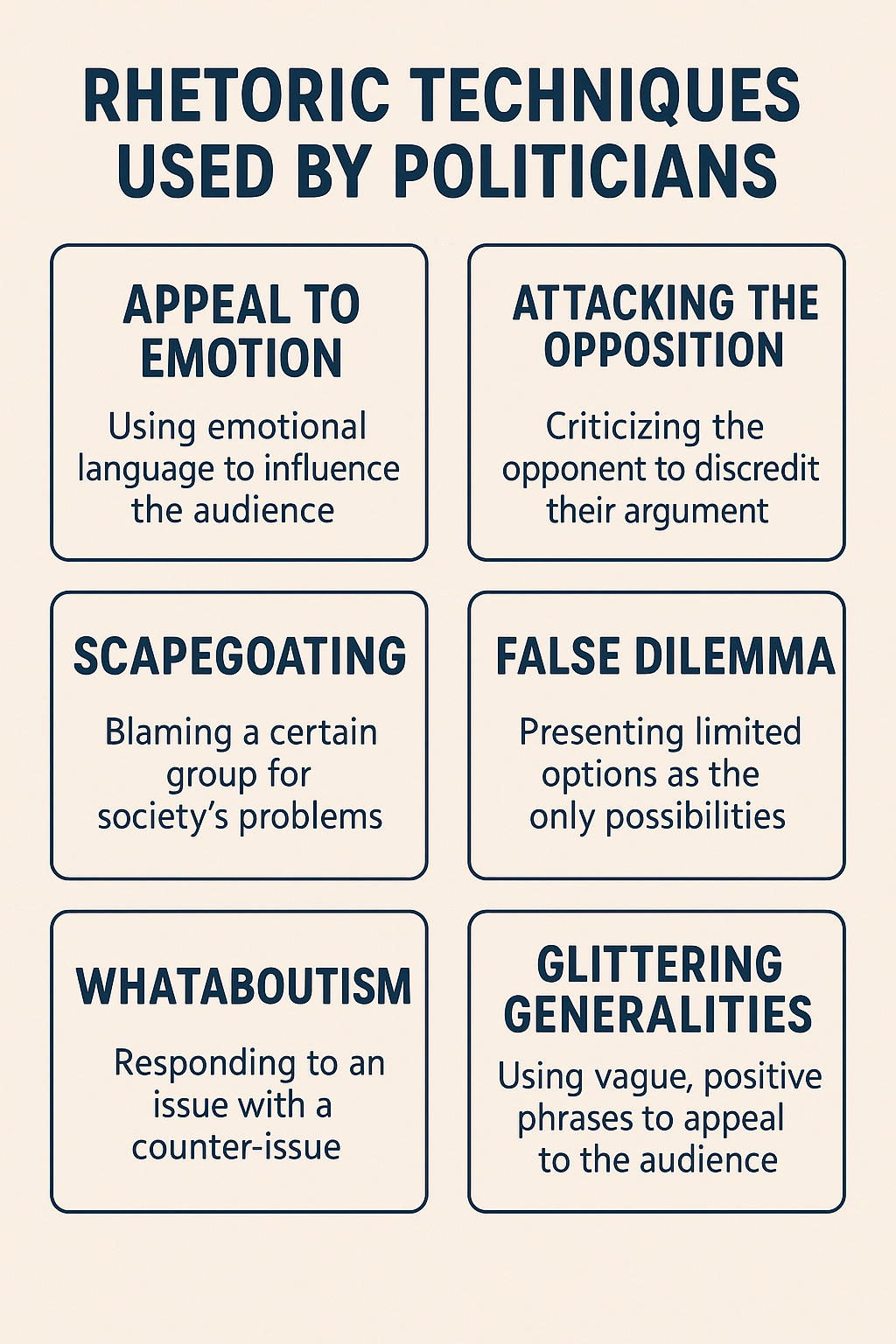
The Use of Scapegoats
A longstanding rhetorical device: assigning blame to a specific group or factor.
Scapegoating allows a politician to:
Redirect frustration
Simplify complex failures
Rally supporters around a shared enemy
It’s powerful, but dangerously reductive.
Symbolic Language
Politicians know humans think in symbols, not spreadsheets.
Symbolic language invokes:
National imagery
Cultural touchstones
Metaphorical journeys
Symbols create emotional shorthand that binds audiences together.
Conclusion
Political rhetoric is a crafted blend of psychology, storytelling, and strategy. Understanding these techniques lets you see the gears beneath the speeches, the narrative scaffolding behind the talking points, and the intentional design of every public-facing moment.
When you recognize rhetoric in real time, you move from being influenced to becoming an observer of influence. It sharpens your political literacy and strengthens your debate skills, especially in environments like Argufight where framing, clarity, and persuasion reign supreme.
Related articles
Should College Athletes Receive a Share of Athletic Revenue?
Debate over whether student‑athletes deserve a cut of the billions generated by college sports.
Human vs. Debate AI: Can an Algorithm Truly Judge an Argument?
Debate AI promises speed and objectivity, but can it truly grasp nuance and persuasion? This post explores ArguFight’s algorithm, its strengths, limits, and why a hybrid human‑AI approach may be the future of fair judging.
How to Use Debate AI to Master Rebuttals, Logic, and Persuasion
Learn how to harness ArguFight’s Debate AI to craft razor‑sharp rebuttals, strengthen logical structure, and boost persuasive power. From evidence sourcing to real‑time feedback loops, this guide shows you step‑by‑step techniques for mastering debate.