The Difference Between Correlation and Causation: Avoiding Misleading Conclusions
Understanding the difference between correlation vs causation is crucial for making valid arguments. Many debates, articles, and claims confuse the two, leading to flawed reasoning. Recognizing the distinction equips you to challenge misleading claims and build stronger evidence-based arguments.
Understanding the difference between correlation vs causation is crucial for making valid arguments. Many debates, articles, and claims confuse the two, leading to flawed reasoning. Recognizing the distinction equips you to challenge misleading claims and build stronger evidence-based arguments.
What Is Correlation?
Correlation occurs when two variables move together. This doesn’t necessarily mean one causes the other.
Positive correlation: both variables move in the same direction.
Negative correlation: variables move in opposite directions.
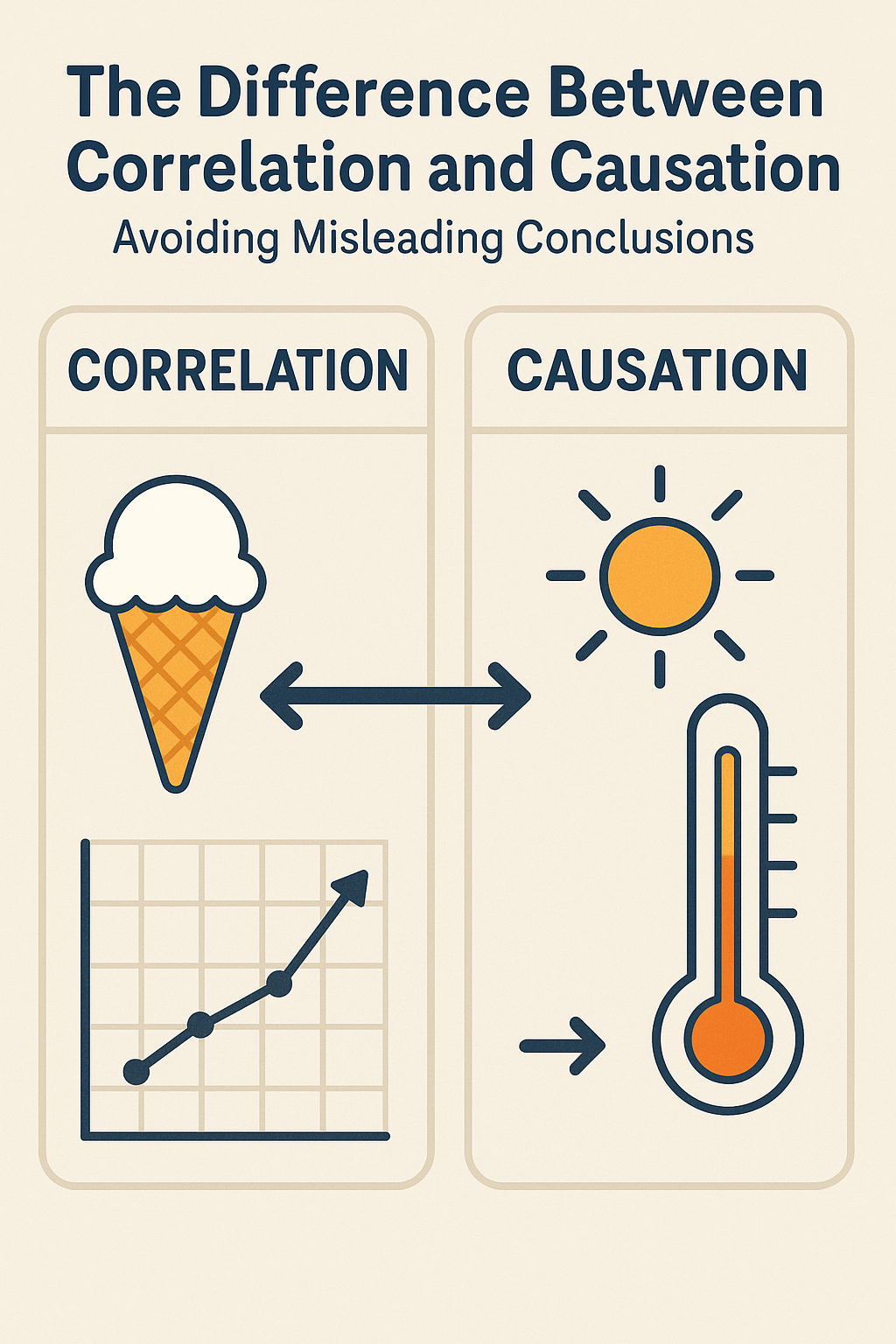
Example: Ice cream sales and drowning incidents rise together in summer. Correlated, but one doesn’t cause the other.
What Is Causation?
Causation happens when one variable directly affects another.
Example: Pressing a light switch causes the light to turn on. There’s a direct causal relationship.
Causation requires more rigorous proof than correlation.
Common Misconceptions
Mistaking Correlation for Causation
Just because A and B happen together doesn’t mean A caused B.
Always ask: Could it be coincidence or a third factor?
Ignoring Confounding Variables
A third variable may influence both A and B.
Example: Hot weather increases both ice cream sales and drowning incidents.
Reverse Causation
Assuming A causes B, when B actually causes A.
Example: Stress causes sleep deprivation vs. sleep deprivation causes stress.
How to Identify Causal Relationships
Temporal precedence: Cause must happen before effect.
Covariation: Changes in cause relate to changes in effect.
No alternative explanations: Rule out confounding factors.
Mechanism: There should be a logical pathway from cause to effect.
Correlation and Causation in Debates
Don’t accept claims solely based on correlation.
Question evidence and look for causal proof.
Highlight missing confounding variables.
Use examples to illustrate misleading correlations.
Tip: Well-chosen analogies help make your point memorable.
Practical Examples
Example 1: Health Claims
Claim: Eating chocolate is linked to Nobel laureates.
Analysis: Correlation only; no evidence that chocolate causes brilliance.
Example 2: Economic Policies
Claim: Cities with more public parks have higher property values.
Analysis: Correlation exists, but causation may involve other factors like neighborhood income or amenities.
Tools for Analysis
Scatterplots to visualize relationships
Regression analysis to explore potential causation
Experimental or longitudinal studies for stronger proof
Conclusion
Understanding correlation vs causation prevents you from drawing misleading conclusions and strengthens your debate skills. By distinguishing between mere association and true cause-effect relationships, you elevate the quality of your arguments and avoid common reasoning traps.
Related articles
Should College Athletes Receive a Share of Athletic Revenue?
Debate over whether student‑athletes deserve a cut of the billions generated by college sports.
Human vs. Debate AI: Can an Algorithm Truly Judge an Argument?
Debate AI promises speed and objectivity, but can it truly grasp nuance and persuasion? This post explores ArguFight’s algorithm, its strengths, limits, and why a hybrid human‑AI approach may be the future of fair judging.
How to Use Debate AI to Master Rebuttals, Logic, and Persuasion
Learn how to harness ArguFight’s Debate AI to craft razor‑sharp rebuttals, strengthen logical structure, and boost persuasive power. From evidence sourcing to real‑time feedback loops, this guide shows you step‑by‑step techniques for mastering debate.