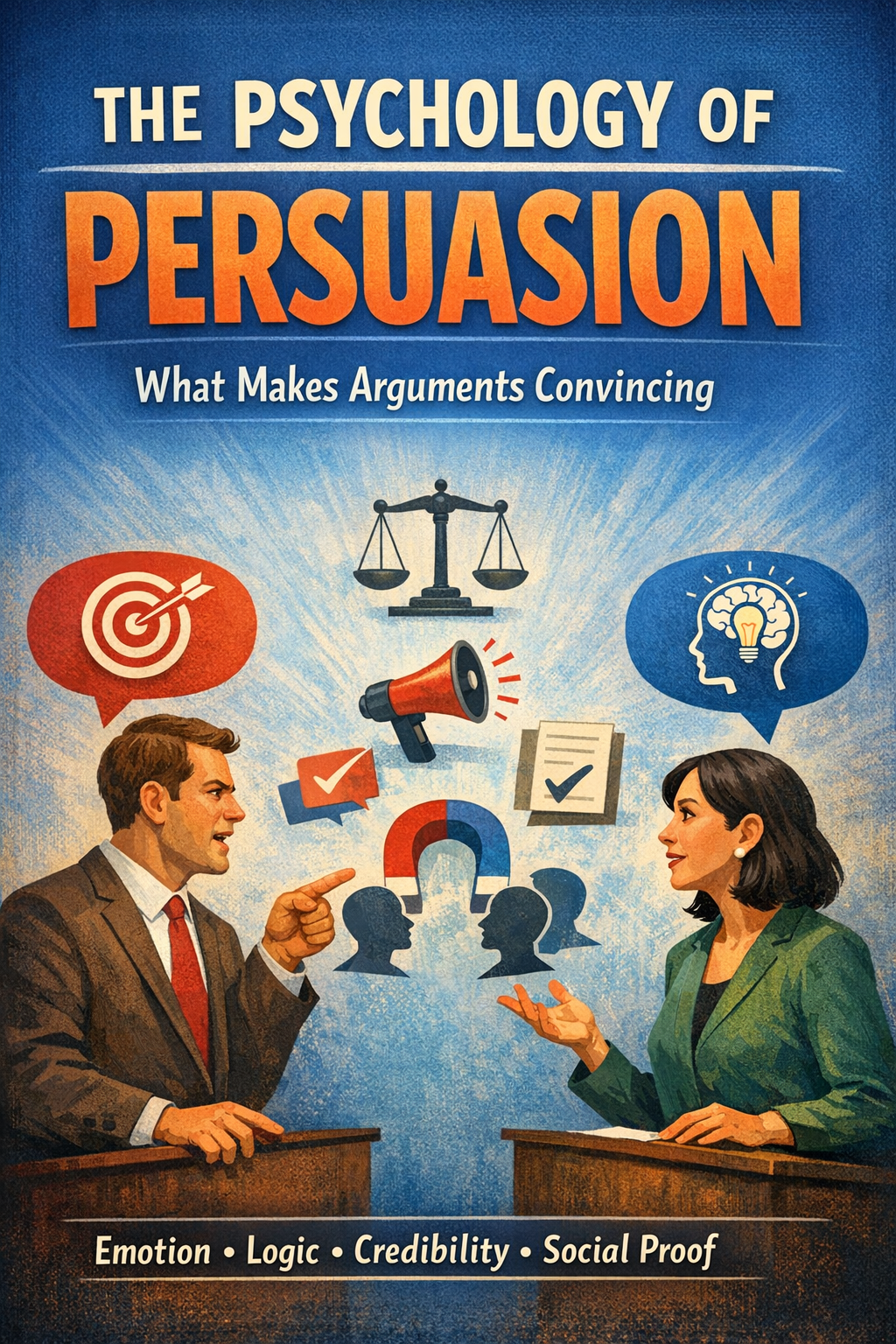
The Psychology of Persuasion: What Makes Arguments Convincing
Why do some arguments change minds while others fall flat—even when they use similar facts? The answer lies in psychology. This article explores the cognitive, emotional, and social mechanisms that make arguments persuasive, explaining how credibility, framing, emotion, and mental shortcuts shape what people find convincing.
Why Logic Alone Rarely Wins
Most people assume that the best arguments are the most logical ones. Present the facts, follow the rules of reasoning, and persuasion should naturally follow. Yet anyone who has debated politics, advertised a product, or tried to change a friend’s mind knows this isn’t how persuasion works in practice.
Arguments succeed or fail not only because of what they say, but because of how human minds work. People interpret information through cognitive shortcuts, emotional filters, social identities, and prior beliefs. An argument that ignores psychology may be logically sound—and still completely ineffective.
The psychology of persuasion studies why certain arguments resonate, why others provoke resistance, and how beliefs actually change. Understanding these principles doesn’t just make you a better debater or communicator—it makes you a more realistic thinker about how influence operates in the real world.
This article breaks down the key psychological mechanisms that make arguments convincing, drawing from cognitive science, social psychology, and persuasion research. Whether you’re debating competitively, writing persuasively, or simply trying to communicate more effectively, these insights explain why some arguments stick.
1. Credibility: Why Who You Are Matters
One of the strongest predictors of persuasion is source credibility. Before people evaluate your argument, they subconsciously evaluate you.
Psychologists typically break credibility into two components:
Expertise: Do you seem knowledgeable or competent?
Trustworthiness: Do you seem honest and fair?
When credibility is high, audiences are more likely to accept claims with minimal scrutiny. When credibility is low, even strong evidence is viewed skeptically.
Importantly, credibility is contextual. A medical professional discussing health policy may seem authoritative, while the same person speaking on economics may not. Effective persuaders signal relevant expertise without exaggeration.
In debate and argumentation, credibility is built through:
Clear explanations
Accurate use of evidence
Willingness to acknowledge limits or uncertainty
Ironically, admitting what you don’t know often increases trust more than projecting false certainty.
2. Cognitive Ease: The Power of Simplicity
Human brains prefer information that is easy to process. Psychologists call this cognitive ease. Arguments that feel simple, fluent, and familiar are more likely to be accepted as true.
This does not mean people consciously think, “This is easy, so it must be right.” Instead, ease creates a subtle sense of comfort that people misattribute to correctness.
Factors that increase cognitive ease include:
Clear structure
Familiar language
Logical flow
Repetition of key ideas
Conversely, arguments that are dense, jargon-heavy, or poorly organized feel harder—and are judged more harshly.
This explains why slogans, sound bites, and analogies can outperform detailed explanations in persuasive contexts. Simplicity is not the enemy of truth, but unnecessary complexity often is.
3. Emotion: The Engine of Persuasion
Emotion plays a central role in persuasion. People do not reason like detached computers; emotions shape attention, memory, and motivation.
Different emotions persuade in different ways:
Fear motivates avoidance and urgency
Anger increases confidence and moral certainty
Hope encourages openness and long-term thinking
Empathy fosters identification and concern
Effective arguments often combine emotional resonance with rational support. Emotion grabs attention; reasoning gives justification.
Problems arise when emotion replaces reasoning entirely. Audiences may be moved in the moment but remain unconvinced long-term.
The most persuasive arguments make people feel something—and then explain why that feeling makes sense.
4. Framing Effects: How Presentation Changes Perception
Psychological research consistently shows that how information is framed can dramatically alter reactions—even when the underlying facts are identical.
For example:
A policy framed as “saving 90% of lives” feels more appealing than one that “kills 10%,” despite being mathematically equivalent.
Framing influences persuasion by:
Highlighting certain values
Activating specific mental associations
Defining what feels at stake
Skilled arguers choose frames that align with their audience’s priorities. An economic argument framed around fairness may persuade one group, while the same argument framed around efficiency persuades another.
Understanding framing does not require manipulation—it requires awareness that presentation shapes interpretation.
5. Cognitive Biases: The Mental Shortcuts That Shape Belief
Humans rely on cognitive biases to navigate a complex world. These shortcuts save time but distort judgment.
Some of the most persuasion-relevant biases include:
Confirmation bias: Favoring information that supports existing beliefs
Availability heuristic: Judging likelihood based on memorable examples
Anchoring: Relying heavily on the first information encountered
Status quo bias: Preferring existing conditions over change
Persuasive arguments often work with these biases rather than against them. For example, introducing a strong initial frame creates an anchor that shapes how later information is evaluated.
Ignoring biases doesn’t eliminate them—it just leaves you unprepared.
6. Social Identity and Group Influence
People are deeply influenced by the groups they identify with. Beliefs are not just opinions; they are signals of belonging.
Arguments that threaten someone’s identity often trigger defensiveness, regardless of logical strength. Conversely, arguments aligned with group values face less resistance.
This explains why:
The same argument persuades one audience and alienates another
Messengers from within a group are often more effective than outsiders
Effective persuasion respects identity. It reframes ideas as compatible with existing values rather than direct attacks on them.
7. Consistency and Commitment
Psychological research shows that people strive for internal consistency. Once individuals commit publicly to a position, changing it becomes psychologically uncomfortable.
Persuasion is often more effective when it:
Encourages small initial commitments
Builds gradually toward larger conclusions
Allows face-saving shifts in position
Rather than forcing dramatic reversals, strong arguments guide audiences step by step.
8. Counterarguments and Resistance
Paradoxically, acknowledging counterarguments can increase persuasiveness. This technique, sometimes called inoculation, prepares audiences to resist opposing views.
When you address objections fairly:
You signal confidence
You increase credibility
You reduce the impact of later rebuttals
Arguments that pretend opposition doesn’t exist often appear naïve or dishonest.
9. Repetition and Memory
Persuasion is rarely instantaneous. Repeated exposure increases familiarity, and familiarity breeds acceptance.
This effect explains why consistent messaging over time is so powerful. Repetition doesn’t need to be identical—variation around a core message often works best.
Memorable phrasing, metaphors, and examples help arguments stick long after the discussion ends.
10. The Limits of Persuasion
Not all arguments can persuade all audiences. Strong prior beliefs, identity threats, and emotional investment can make some minds resistant to change.
Understanding psychology helps set realistic goals:
Sometimes persuasion means softening opposition, not converting it
Sometimes success means planting a seed, not winning immediately
Recognizing these limits prevents frustration and encourages strategic patience.
Conclusion: Convincing Minds Means Understanding Them
The psychology of persuasion reveals a humbling truth: humans are not purely rational evaluators of arguments. We are emotional, social, biased, and deeply influenced by context.
This does not mean persuasion is dishonest or manipulative. At its best, it aligns good reasoning with how people actually think. Convincing arguments respect both logic and psychology.
When you understand what makes arguments convincing—credibility, clarity, emotion, framing, and identity—you become a more effective communicator and a more empathetic thinker.
In persuasion, the strongest arguments are not those that overpower the mind, but those that work with it.
Related articles
Should College Athletes Receive a Share of Athletic Revenue?
Debate over whether student‑athletes deserve a cut of the billions generated by college sports.
Human vs. Debate AI: Can an Algorithm Truly Judge an Argument?
Debate AI promises speed and objectivity, but can it truly grasp nuance and persuasion? This post explores ArguFight’s algorithm, its strengths, limits, and why a hybrid human‑AI approach may be the future of fair judging.
How to Use Debate AI to Master Rebuttals, Logic, and Persuasion
Learn how to harness ArguFight’s Debate AI to craft razor‑sharp rebuttals, strengthen logical structure, and boost persuasive power. From evidence sourcing to real‑time feedback loops, this guide shows you step‑by‑step techniques for mastering debate.